
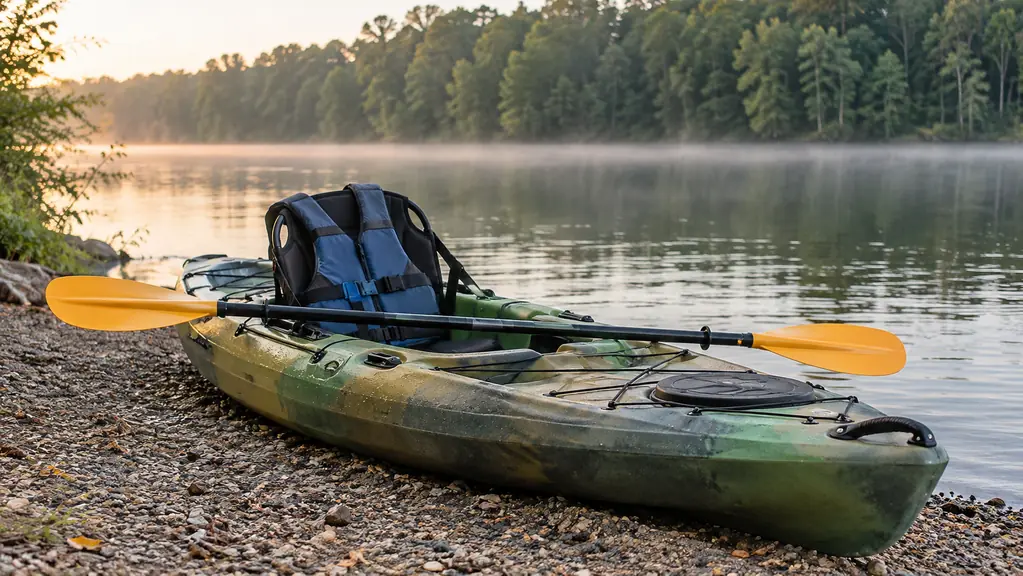
The life jacket that came with my used kayak was fine for about twenty minutes. Then it rode up against the seat back, I tugged it down, and a few strokes later it climbed right back up toward my ears. So I took it off and tucked it under the deck bungee while the sun beat down on the water. That was the entire problem. Not that the old jacket was unsafe. It floated, it was approved, it did its job. It was just uncomfortable enough that I kept finding reasons to take it off.
In May 2025 I bought an Onyx MoveVent in size Medium-Large, and that habit ended. It's a vest cut for paddling rather than for sitting still in a boat with a motor on the back. It isn't fancy. But it's the first vest I've owned that I put on in the gravel lot and then forget about for three hours. Here are ten reasons I think a vest shaped for paddling is worth the money, and I'll tell you the parts that aren't perfect, because there are a couple.
The vest I put on in the gravel lot and stop thinking about by the ramp
Onyx MoveVent Dynamic Paddle Vest, Medium-Large. Mesh back panel for a kayak seat, adjustable side belts and shoulder straps, neoprene at the shoulders, built-in whistle. U.S. Coast Guard and Transport Canada approved.
Amazon Check Today's Price on Amazon →It stays where you put it when you twist to look behind you
On the old jacket, turning to check behind me meant the whole thing slid up. I'd tug it down, paddle a few strokes, and it would creep up again, all afternoon. The Onyx has adjustable side belts and shoulder straps, and the side belts are the ones that matter. Snug them at the waist and the vest stops climbing. It took me a few trips to get them where I wanted them, and I'll say that plainly rather than pretend it fit perfectly out of the box.
The mesh back panel works with a kayak seat instead of against it
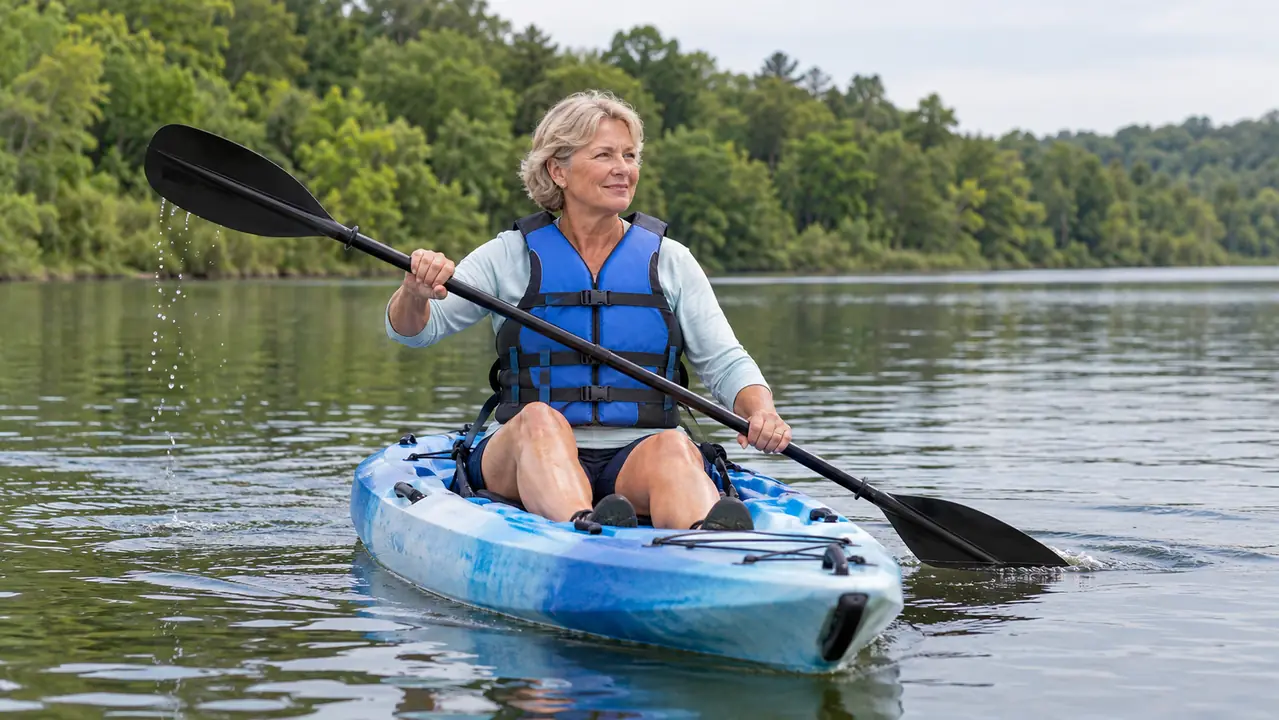
My kayak has a padded seat with a backrest, and the old foam jacket was a solid slab that pressed into it. The Onyx MoveVent has a mesh panel across the back built to accommodate most canoe and kayak seats. On a sit-on-top, that means the seat back and the vest aren't shoving each other around all afternoon. I noticed it the first trip and I still notice it on a long one. This is the single biggest reason I stopped taking the vest off mid-paddle.
The armholes are cut wide enough that a full stroke doesn't rub
Large armhole openings, is how the listing puts it, and it's accurate. I can reach forward, plant the blade and pull back without the vest catching my upper arm or dragging across it. With the old jacket I was shortening my stroke without realizing I was doing it, mostly to keep from chafing. I'm 5 foot 5 with ordinary shoulders and no particular reach. In the Medium-Large I paddle the way I paddle when I'm not wearing anything at all.
Neoprene at the shoulders means no raw spots on a hot day
The shoulder area is neoprene, which is a soft, slightly stretchy material. On a July afternoon in a t-shirt, that's the difference between finishing the day comfortable and finishing it with a red line across each shoulder. I paddle in short sleeves from April through October, so this mattered more than I expected it to. It also means I'm not layering a sweatshirt underneath just to protect my skin, which on a Virginia summer day would be its own problem.
The size range is honest, which is more than I can say for some
The Medium-Large is rated for people from 90 pounds up to 300 pounds. That's a wide window, and it's the reason a woman my size and a big man at the ramp can both wear the same size and get a real fit out of it. The adjustment comes from the side belts and the shoulder straps, not from the shell, so it tightens down where it counts. Have somebody at the launch check the fit before you commit to it. A vest you can pull off over your head without unzipping is too loose.
The buckle and zipper go on in about fifteen seconds
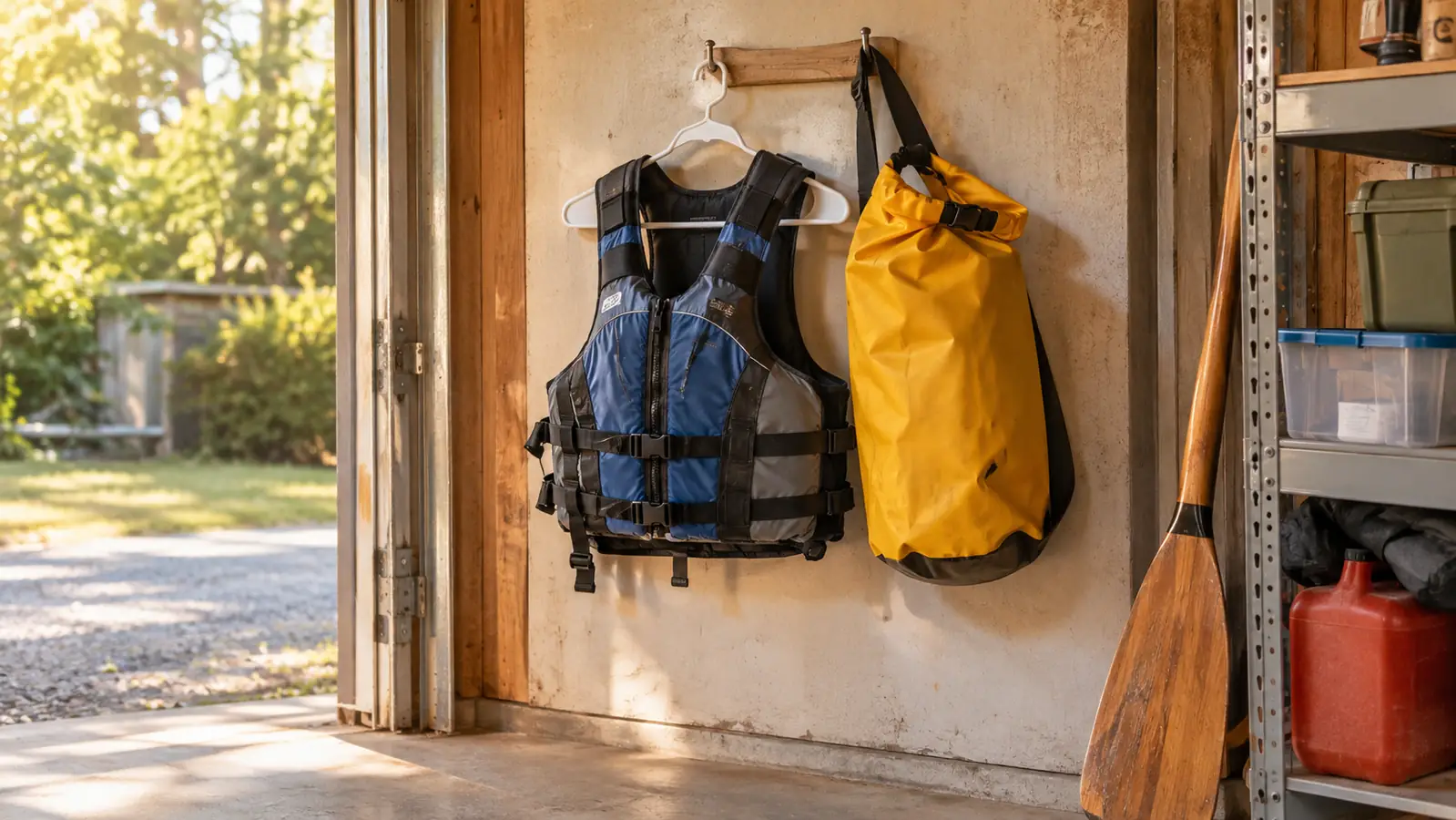
There's a zipper down the front and a buckle across it. That's the whole procedure. Two steps, no straps to thread through loops, no hunting for a clip behind your back. I put mine on in the parking lot before I unload anything, and I don't vary that. When something takes fifteen seconds you do it without thinking. When something takes a minute and a half of fussing, you start finding reasons to leave it in the truck, and I know that because I used to be that person.
The whistle is attached, so it's actually with you
There's a built-in whistle on the vest. I carried a loose whistle in my lunch cooler for two years and I could not have told you where it was without digging through a sandwich and a towel to find it. Having one sewn onto the thing I'm wearing is the difference between owning safety gear and having safety gear on your body. I've never needed it. I like knowing it's right there and not at the bottom of a bag.
The reflective accents are there for the boat that doesn't see you
The vest has SOLAS-grade reflective accents on it. I don't paddle at night. I paddle daylight, two trips a month, and I'm off the water well before supper. But Claytor Lake has motorboats on it, and a gray afternoon over gray water is not a high-contrast situation for anybody. Anything on me that catches light is worth having. I can't tell you exactly how much difference it makes. I can tell you I'd rather have it than not have it.
It weighs 1.7 pounds, so I never think about taking it off
The listed weight is 1.7 pounds. That's not nothing on your shoulders, but it's light enough that after the first half hour I stop noticing I have it on. That's really the whole argument. A vest that's comfortable is a vest that stays on for the trip instead of just the launch and the first twenty minutes, and every other reason on this list is in service of that one. My old jacket never got past the twenty minute mark.
It's approved, and the approval is printed on the label
The Onyx MoveVent is U.S. Coast Guard approved and Transport Canada approved. I'm not going to quote you a regulation, because I'm not qualified to and you can read the label yourself. What I'll say is that a paddling vest has to be the right kind of flotation, not just any jacket that happens to float. This one is rated for the kind of paddling I do and it says so in print. That's worth something when you're alone a couple hundred yards from the ramp with nobody watching.
A vest you take off is a vest that isn't on you when the wind picks up at the far end of the lake. Mine stays on now, and that is the only safety feature that has ever really counted for me.
What I'd Skip
I'd skip buying a general purpose life jacket for kayaking, and I say that as somebody who used one for two seasons. The old blocky jacket that came with my boat was built for sitting upright on a bench seat. It was safe and it was miserable, and a miserable vest lives under a bungee cord. If you paddle, get something shaped for paddling. That's the whole lesson I learned, and it cost me two summers of not wearing the thing I'd paid for. I'd also skip the idea that you only put a vest on when the water's cold or the wind's up. I wear mine the entire time I'm on the water, every trip, and I have since the May I bought it. It goes on in the parking lot before anything comes out of the truck.
What I wouldn't skip, and won't pretend away: this vest is still warm in August. The mesh back helps, but a 90 degree afternoon on Claytor Lake is a 90 degree afternoon, and I'm damp when I get back in the truck. It also took me a few trips to get the side belts dialed in, and until I did, the fit was just average. Nothing about those two things has made me want to go back to the old jacket. If you have a real back or shoulder problem, talk to a doctor about what you can wear comfortably. I'm a retired bus dispatcher, not an instructor.
The best vest is the one still on you at the far end of the lake
Onyx MoveVent Dynamic Paddle Vest, Medium-Large, rated 90 to 300 pounds. Mesh back panel, adjustable side belts and shoulder straps, neoprene shoulders, built-in whistle. I'd buy it again, warm August afternoons and all.
Amazon See Today's Price on Amazon →