
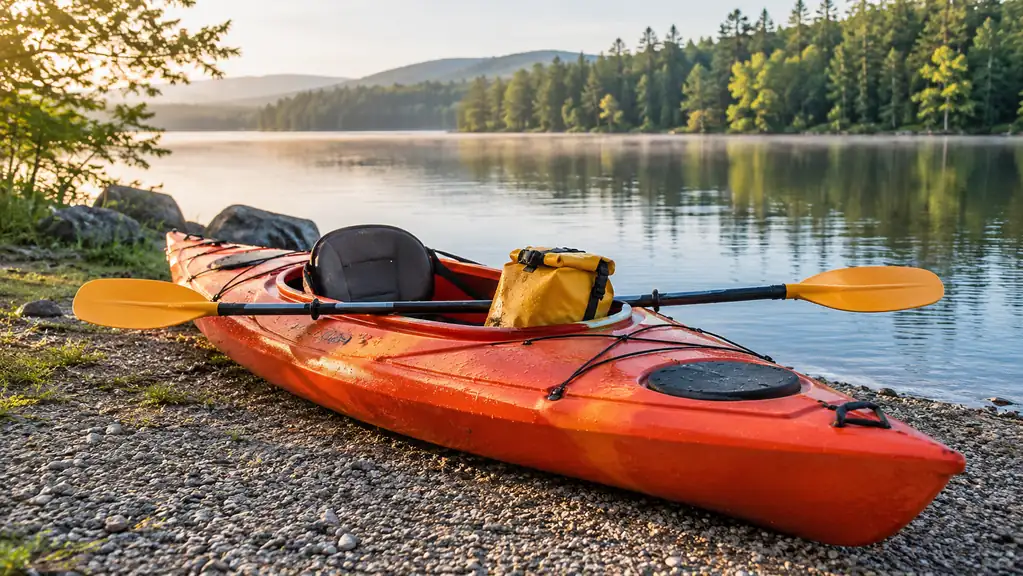
I bought the HEETA dry bag in July 2024, a little over two years ago, after a June trip on Claytor Lake taught me a lesson I did not want to learn twice. I had my phone in a zip sandwich bag inside a lunch cooler. Water got in anyway. The phone would not turn on for two days, then it came back, and I decided I was done trusting a sandwich bag with something I did not want to replace. The HEETA was the first piece of kayak gear I bought with my own money, one item at a time, and it has been clipped to a deck strap point on my used 10 foot sit-on-top ever since.
I am 58, retired from dispatching school buses in Radford, Virginia, and I paddle Claytor Lake and the calm stretch of the New River about twice a month from April through October. I am not an instructor or a gear expert. I am a woman with a 50 pound kayak, an older Toyota Tacoma, and a husband named Ron who does not paddle but likes to know where I am and when I will be back. This review is what I would tell Sheila at the boat ramp, not what a catalog would tell you.
The Quick Verdict
A small, simple waterproof bag that solved my phone problem, with a size limit and a see-through body you need to accept.
Amazon Check Today's Price →The bag that ended my sandwich bag gamble
I still use the 5 liter HEETA every trip for my phone, keys, wallet, towel and lunch. If that is your list, start here.
Amazon Check It on Amazon →What the HEETA Dry Bag Actually Is
The HEETA bag I own is the 5 liter size, made from PVC, 0.6 mm thick at the bottom and 0.3 mm on the sides, with a roll-down top and a buckle closure. It measures 8 inches long, 8 inches wide and 13 inches high. It has one adjustable strap and a side handle, and no pocket. HEETA makes it in 5, 10, 20, 30 and 40 liter sizes, and I own the 5 liter. I have not owned another size, so I can only tell you how this one behaves.
The material is the part I care about. It is not a fabric sack that soaks through. It is a PVC bag with a stiff enough bottom to sit upright on the deck while I load it. The top rolls down and the two ends of the buckle meet in the middle. That is the whole system. There is no zipper to gum up with lake grit and no pocket to trap water. Simple is good on a kayak, because simple is one less thing to fiddle with while the wind pushes you toward the dock.
How I've Used It
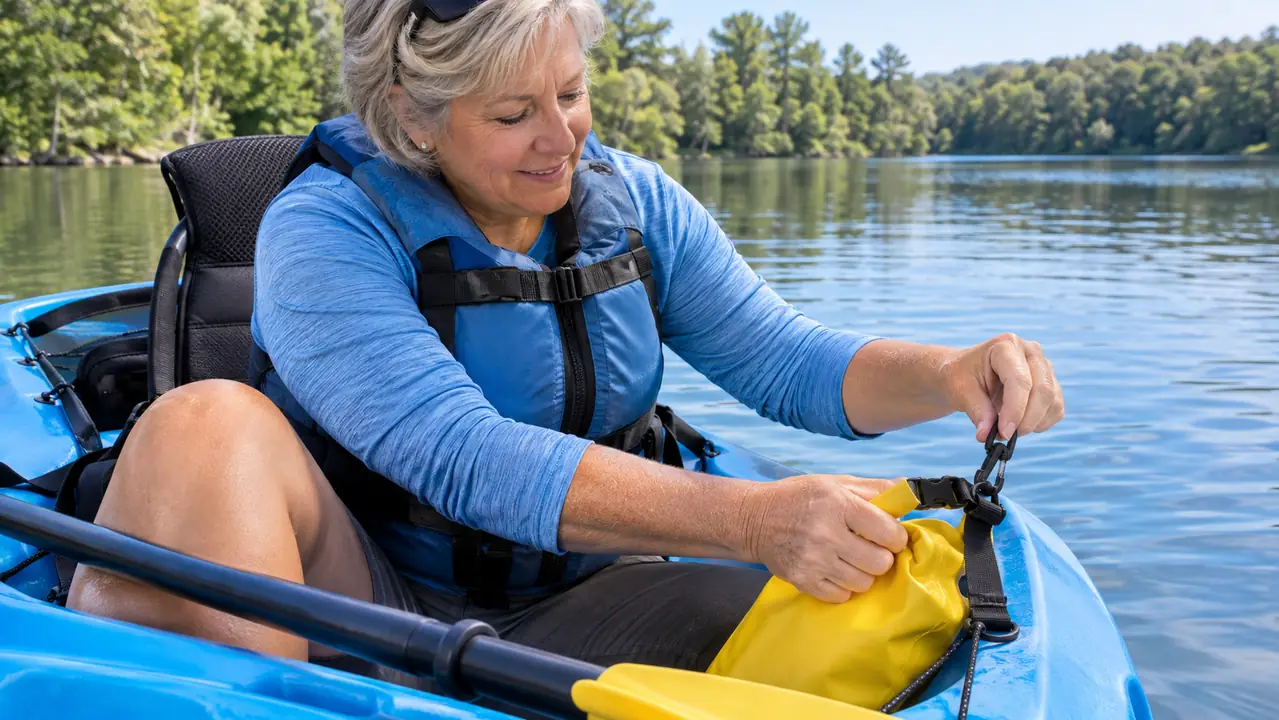
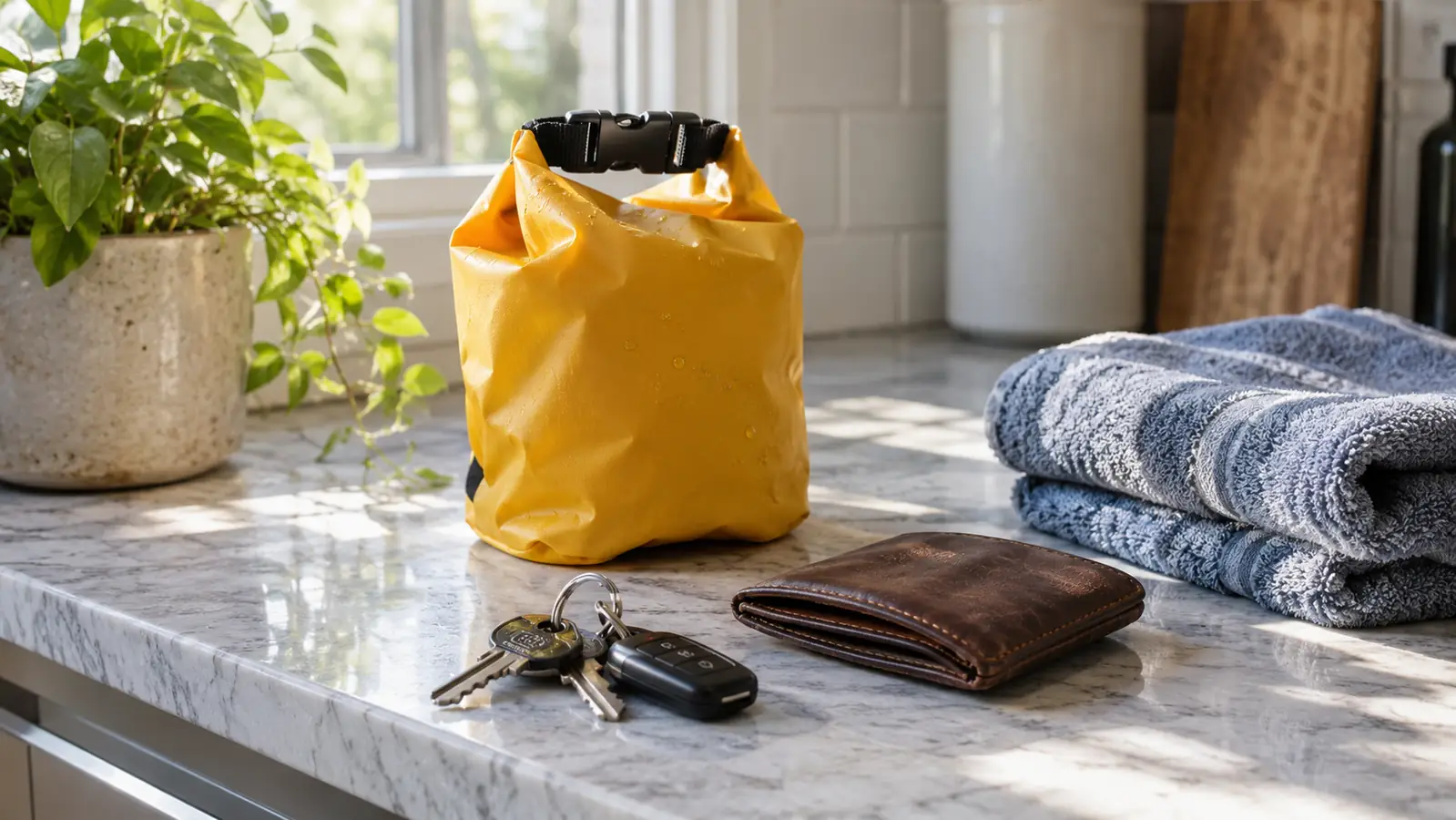
My routine has not changed much. The night before a trip, I pack the HEETA bag on the kitchen counter. Phone, keys, wallet, a small towel and a sandwich go in. The phone goes straight into the bag, not into a separate pouch. In the morning I put the bag on the passenger seat of the truck beside my vest, and at the launch I clip it to one of the deck strap points in front of the seat. The bag rides there all day. I open it at lunch, close it again, and take it off when I load the kayak back on the truck.
I have used it on calm water only, on Claytor Lake and the New River near Radford, in daylight, April through October. I have never taken it into whitewater, surf or salt water, and I have never camped overnight with it. That matters for this review. If you paddle big water or take multi-day trips, my experience will not tell you what you need to know. For a day on flat water, it has been enough.
The first few trips I overthought the roll. I rolled the top down three times, pushed the air out, and snapped the buckle. Then I checked it by holding the bag upside down over the dock. No water came out and no water went in. I do not do the upside-down test every trip now. I just roll it the same way, buckle it, and trust it. Two years of that routine and my phone has stayed dry.
What Stays Dry
The short answer is everything I put inside stays dry when I close it correctly. My phone is the test case because it is the reason I bought the bag. It has stayed dry on every trip since July 2024. My keys, wallet, towel and sandwich have stayed dry too. The outside has gotten wet from my hands and from the deck, and the inside was still dry when I opened it at the truck. I am not saying it will survive being dragged behind a boat. I am saying it does the job I bought it for.
The buckle is the part that gives me confidence. It is a simple buckle, and when both ends are clicked it takes a deliberate squeeze to open. I have never had it pop open on its own. The roll-down top needs a few folds to work, and the bag is stiff enough that the folds stay put while I snap it. If you have arthritic hands, the buckle is not hard to work, but the PVC does not stretch, so you need to line the two ends up rather than force them.
What Does Not Stay Dry
The outside of the bag gets wet. That sounds obvious, but it is worth saying because the strap and the deck around it will be wet when you pick it up. The bag is not a towel. If you set it down in the bottom of the kayak where water pools, the outside will be wet and the inside will still be dry as long as the top is buckled. I have not had water inside, but I also have not left it open in the rain. An open dry bag is just a bucket.
The other thing that does not stay dry is anything you leave out of the bag. I keep my phone in it, but my hat and my sunglasses do not fit well once the towel and sandwich are in. On a hot day I want my hat on my head anyway. The point is that 5 liters fills up faster than you think. If you plan to carry a change of clothes, a jacket, or a thermos, this size will not do it. You would need a larger size, and I cannot tell you how those carry because I have only owned the 5 liter.
Two years of calm-water trips and my phone has stayed dry. The limit is not the seal. The limit is the five liters.
The Size Problem Nobody Mentions
The 5 liter bag is about the size of a small stuff sack. It holds my phone, keys, wallet, a hand towel and a sandwich with a little room to spare. It will not hold a change of clothes. It will not hold a hoodie. It will not hold a water bottle unless it is a very small one and you give up the sandwich. If you read a review that says it is roomy, check what they were carrying. Room is relative. My usual load is small, and it is still a tight pack by the end of the morning.
The see-through body is a trade. I can find my keys without dumping everything on the dock. That is a real help when the gravel parking lot is full and I am trying to get moving. The trade is that everyone can see what is inside. If you carry medication, cash, or anything you would rather keep private, this is not the bag for that. Sheila carries an opaque roll-top sack, and she does not have that problem. I have handled her sack on trips, but I have never owned one.
How It Carries on the Deck
The bag has one adjustable strap and a side handle. I use the strap to clip it to a deck strap point, and the handle is handy when I am carrying it from the truck to the launch. The strap is not padded, and if you carry the bag by the strap over your shoulder for a long walk, it will dig in a little. My walk is a couple hundred yards down a gravel lot and grass to a concrete ramp. By the time it starts to bother me, I am at the water. If you have a longer portage, keep that in mind.
On the deck, the bag sits in front of the seat and does not slide around much. The PVC has enough grip to stay put on the plastic hull, and the strap keeps it from going over the side. I have not had it come loose. I also have not tested it in a capsize because I have never capsized. I cannot tell you how it behaves if you swim. I can tell you it is clipped on, and that is the most I can honestly say.
Durability After Two Years
The bag has no tears, no cracks, and no sticky spots. The buckle still snaps. The strap still adjusts. I rinse it with the garden hose after every trip and let it dry in the garage with the top open. That is the whole maintenance routine. I do not wax it, spray it, or treat it with anything. The PVC has stayed flexible enough to roll. The bottom, which is the thicker part at 0.6 mm, has not worn through from sitting on the deck.
I have not been gentle with it. It gets tossed in the truck bed beside the kayak, set on gravel, and stuffed with lunch. It still looks like a used bag, not a new one. There are scuff marks on the outside. That is normal. If you want a bag that stays looking new, this is not it. If you want one that keeps your phone dry and does not require much care, the scuffs do not matter.
Comfort and Handling on the Water
This is not a backpack you wear while paddling. It is a small bag you clip to the deck. That is how I use it, and that is how it works best for me. The adjustable strap is long enough to go over a shoulder, but I would not want to hike with it. The side handle is more useful. When I get to the launch, I grab the handle, carry it to the kayak, and clip it on. There is nothing to adjust after that.
The bag does not get in the way of my paddle stroke. It sits low in front of the seat, and my knees do not hit it. If you have a smaller cockpit or you store gear between your legs, you may need to find a different spot. I have four strap points on my deck for the seat, and I use one of the front ones for the bag. That has worked for me. It might not work on every kayak.
What I Liked
- The roll top and buckle have kept my phone, keys, wallet and lunch dry for two years of calm-water trips.
- It is simple to use, with no zipper or pocket to fuss with on the water.
- The adjustable strap and side handle make it easy to carry from the truck to the launch.
- The see-through body helps me find small items without emptying the whole bag.
- Rinses clean with a garden hose and needs no special care.
Where It Falls Short
- Five liters is too small for a change of clothes or a jacket.
- The see-through body shows everyone what you are carrying.
- There is no pocket for a map or a snack you want to reach quickly.
- The strap is not padded, so a long carry is not comfortable.
- The outside gets wet and stays wet until it dries.
What I'd Change
I would add a small exterior pocket for a map or a granola bar, but the specs say no pocket, and that is what I bought. I would make the strap a little wider, because a narrow strap with a loaded bag is not comfortable on a long walk. I would not change the roll top. The buckle works. The size is the main thing. HEETA does make larger sizes, including 10 liter, 20 liter and up. I have not owned them, so I cannot say how they carry. I can say that if I wanted to carry a jacket, I would be looking at the larger sizes, not this one.
Who This Is For
This bag is for the paddler who carries a small set of things and wants them dry. Phone, keys, wallet, a small towel, a sandwich. That is my list. If it is your list, the 5 liter HEETA does the job. It is also for someone who does not want to mess with a zipper or a complicated closure. Roll it, buckle it, clip it on. That is the whole process. It is good for calm lakes and slow rivers, for day trips, and for people who paddle a few times a month like I do.
It is also a good first dry bag because it does not ask much of you. You do not need to learn a new system. You do not need to treat the material. You rinse it and let it dry. For a beginner, that matters. A bag that is easy to use is a bag you will actually use.
Who Should Skip It
Skip it if you need to carry clothes, a jacket, or a full lunch for two. Five liters will not do it. Skip it if you want your valuables hidden. The bag is see-through, and everyone at the launch can see your wallet. Skip it if you paddle whitewater, surf, or take overnight trips, because I have no experience there and this bag is not the one I would choose for that without knowing more. Also skip it if you want a bag with pockets or a padded strap. This one has neither.
If you already have a larger dry bag, you may not need this one. Sheila has her roll-top sack and she is happy with it. I have handled it, and it is a good bag. I did not buy one because the HEETA was the first one I tried and it solved my problem. If you are starting from nothing and you carry a small load, the HEETA is a reasonable place to start.
If your phone rides in a sandwich bag, this is the upgrade I made
The 5 liter HEETA has kept my phone, keys and lunch dry for two years of calm-water day trips. It is small by design. Check the size against your own list before you buy.
Amazon See the HEETA Dry Bag on Amazon →