
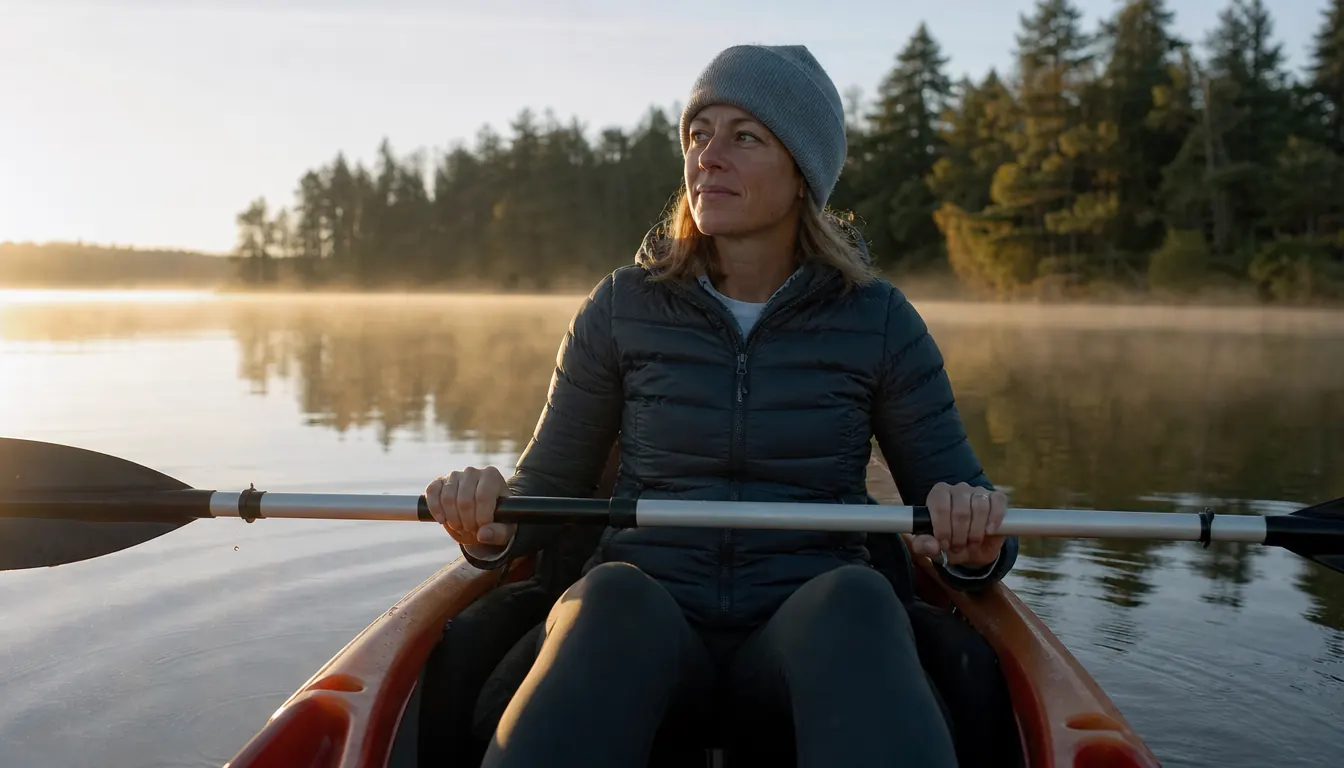
The paddle that came with my used kayak was short and heavy, and I never once thought about whether it fit me. I just used it because it was there. When I handed it back to the neighbor and bought my own, I stood in front of a screen trying to figure out which of three lengths to pick, and every guide I found assumed I already knew what a torsion was.
Here is what I actually learned, and it is not complicated. Paddle length comes down to two things: how tall you are, and how wide your kayak is. Everything after that is adjustment, not selection. I ended up with the OCEANBROAD paddle in the 230 cm length, which is the middle of the three sizes they make, and it has been my only paddle for about twenty months on Claytor Lake and the calm stretch of the New River. This is the process I would hand to anybody starting from zero.
Three lengths, one of them is yours
The OCEANBROAD comes in 218 cm, 230 cm and 241 cm. The sizing steps below tell you which one fits your height and your boat, so you are not guessing at checkout.
Amazon Check the current price on Amazon →Step 1: Match the length to your height first
Before you look at your kayak, look at yourself. Stand against a wall and have somebody put a pencil mark at the top of your head, or just use the height on your driver's license, which is close enough. I am 5 foot 5, and I know that number without measuring because it has not changed since I was fifty.
The general rule for a recreational kayak is that a paddler under about 5 foot 5 sits in the shorter end of the range, a paddler from roughly 5 foot 5 to 5 foot 11 sits in the middle, and a paddler over about 5 foot 11 sits in the longer end. That is not a law, it is a starting point, and Step 2 is what moves you off it one direction or the other.
What that meant for me: at 5 foot 5, I was right on the line between the short length and the middle length. The OCEANBROAD sizes are 218 cm, 230 cm and 241 cm, which on the label read as 86 inch, 90.5 inch and 95 inch. I was choosing between 218 cm and 230 cm and I did not know yet which way to go. If you are in the middle of the range like I was, do not pick yet. Step 2 decides it.
One thing worth saying about the height rule: it assumes you are going to paddle with your torso and not just your arms. If you are brand new and you are still muscling the paddle around with your shoulders, a longer paddle will feel easier for a few trips and then start to feel long. I did that. My first two outings with the 230 cm I was reaching too far forward and pulling with my arms, and by the time I came off the water my shoulders were done. It was not the paddle. It was that I was treating it like a rake handle. Once I started turning from the waist and keeping my hands lower, the same length stopped feeling long at all. So do not size up to compensate for a stroke you have not learned yet.
Step 2: Add width for a wide kayak, subtract it for a narrow one
Now the boat. A wider kayak puts the water further out to the side, so you need more paddle to reach it. A narrow kayak lets you use a shorter paddle without burying the blade. My sit-on-top is a 10 foot recreational boat that measures roughly 30 inches across at the widest point, which is typical for that class. I measured it in the garage with a tape because I did not trust the number I remembered from the listing.
The way to think about it: if your kayak is around 28 inches wide or narrower, the height-based length is probably right, or one size down. If it is 30 inches or wider, which most recreational sit-on-tops are, you want to be at the height-based length or one size up. That pushed me from the short end of my range to the 230 cm, and I have never once wished it were shorter.
Sheila's boat is narrower than mine and she uses a shorter paddle than I do. Neither of us is wrong. That is the whole point of doing the two steps in order instead of copying whatever the person next to you is holding.
Where people get this wrong is measuring the wrong part of the boat. I first put the tape across the cockpit opening, which gave me something like 22 inches, and that number would have sent me down a size. The cockpit is not what the paddle has to reach around. You want the widest point of the hull, which on my boat is a little behind the seat where the sides flare out. Lay the tape on the deck across the hull at that point, not across the opening you climb into, and not along the gunwale where the curve makes the tape read short. If you are not sure where the widest point is, measure in three places, front, middle and back, and take the largest.
Step 3: Do the on-boat fit check before you commit
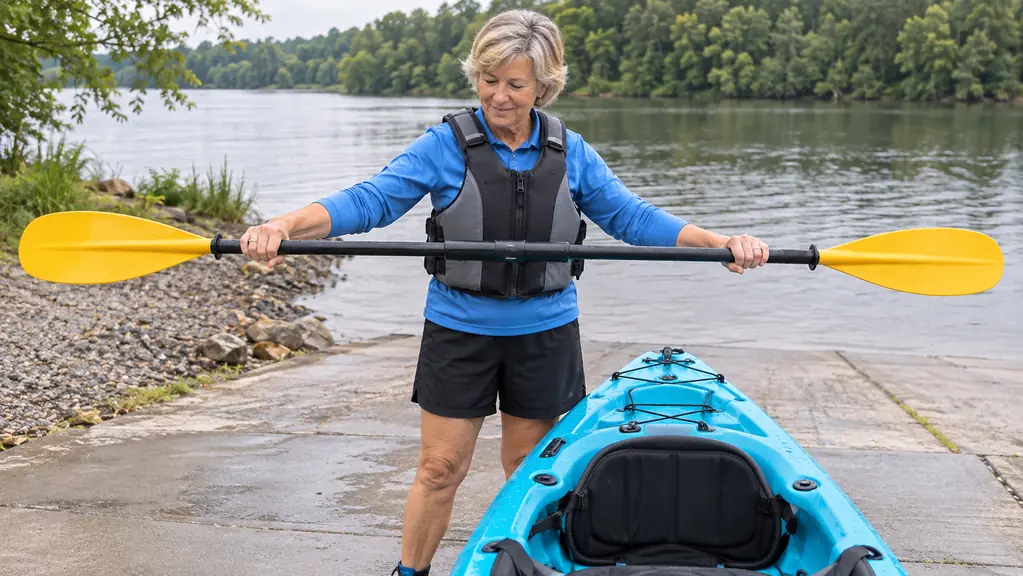
You can check the length before you ever put the paddle in the water, and you should. Sit in the kayak on dry ground or at the ramp with the boat steady. Hold the paddle across your body at about chest height, level, with the shaft in both hands roughly shoulder width apart. Now look at where the blades sit relative to the waterline.
On a correctly sized paddle, the top edge of the lower blade should be around the waterline when you reach forward for a normal stroke, with the whole blade submerged and none of the shaft. If you have to lift your top hand above your shoulder to get the blade in the water, the paddle is too short. If your hands are up around your ears at the catch, that is the same problem. If the blade is buried past the shaft and your top hand is down near your hip, the paddle is too long.
I did this in the gravel lot at the lake with the 230 cm OCEANBROAD before my first trip with it, which is a slightly ridiculous-looking thing to do in public but takes about ninety seconds. The blade sat right at the waterline in my head-height stroke and I stopped second-guessing the size.
If you want a second opinion without getting wet, the paddle length should land somewhere near the distance from the ground to the palm of your raised hand when you stand up straight. It is not exact and it will not settle a 218 against a 230 for you, but it will catch the case where you have bought something a full size off. I checked mine that way in the garage after the fact, mostly out of curiosity, and it came out close enough that I quit worrying about it. The lot check at the ramp is the one I would trust, though, because it puts your actual body in your actual boat.
Step 4: Join the sections and set the locking position
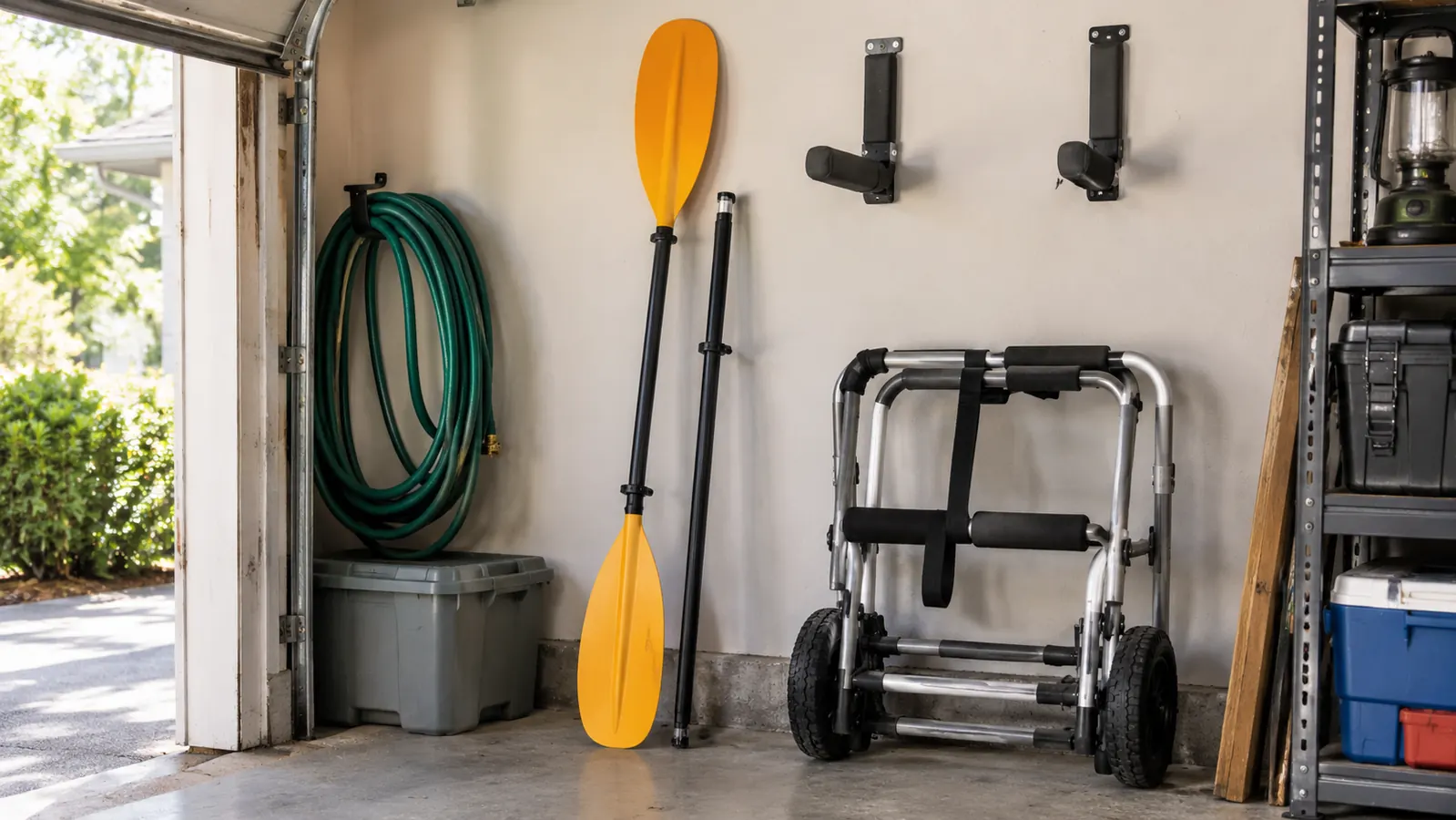
A two-piece paddle is not assembled once and left that way, at least not by me. Mine lives in the garage corner in its two sections because that is how it fits in the truck bed beside the kayak. So assembly is part of every trip, and it is worth doing the same way each time.
The OCEANBROAD has three locking positions, which set the angle of the blades relative to each other. Push the two sections together, line up the button or the collar at the position you want, and seat it fully. Then pull on it firmly to confirm it is locked before you put any weight on it. Mine has never come apart on the water, but I check it anyway because the check costs nothing and a paddle that separates mid-stroke would ruin a morning.
I keep mine on the same locking position every trip and have never had a real reason to change it on the water. Paddlers who swap between a flat blade angle and a feathered one have a use for the other two settings. I do not, and I would rather not fiddle with something I am holding over open water.
The first time I put it together I did it in the garage in about March, before the season started, and I made the mistake of thinking it clicked when it had not. I pushed the sections together, heard a noise, and set it in the corner. A couple of weeks later I picked it up by one blade to move it and the other half slid out onto the concrete. Nothing broke, but it taught me to do the pull test every single time rather than trusting the sound. Now I put it together in the truck bed at the ramp, seat it, give it a solid tug, and only then carry it down. It takes five seconds and it is the only part of the setup I will not skip. Same goes for taking it apart at the end: press the button, not the shaft, or you will fight it.
Step 5: Adjust the grip and the leash, then leave it alone
Two small things decide whether the paddle feels right in your hands for two hours. The first is hand position: your hands should sit roughly shoulder width apart on the shaft, evenly, so the center of the shaft is centered on your body. If you find yourself sliding your hands outward without thinking, the paddle is probably a touch long for you and you are compensating. If your hands are crowding the middle, it is short.
The second is the leash. The OCEANBROAD comes with one, and using it is the difference between a dropped paddle floating beside you and a dropped paddle going somewhere without you. I clip mine and check the clip before I push off, same as I check the vest buckle.
After that, leave it alone. The temptation with an adjustable paddle is to keep adjusting it. Once the length and the locking position are set and the hands are where they belong, the paddle is done, and the rest of the improvement comes from paddling more rather than from turning a collar.
One honest note on the feel, since you will notice it in April. The shaft on mine is an aluminum alloy, and on a chilly morning it is cold in the hands in a way that fiberglass is not. Sheila has a fiberglass paddle and hers does not have that bite to it. I have gotten used to it, and by the time the sun is up and I have been out twenty minutes it is not something I think about, but the first ten minutes of the first few trips it was noticeable. If cold hands are the thing that ruins your mornings, that is worth knowing before you buy rather than after.
The blade sat right at the waterline in my head-height stroke, and I stopped second-guessing the size in about ninety seconds.
What Else Helps
A paddle only does so much if the rest of the setup is fighting you. The seat matters more than I expected. My kayak had a bare molded seat and I used a folded garden kneeling pad on it for a while, and after about an hour my lower back got stiff enough that I turned around early. The padded seat with a backrest I bought afterward changed how long I could stay out, and it also changed my stroke, because I was no longer bracing with my back instead of my torso.
The other piece is the walk to the water. My launch has a gravel lot and a couple hundred yards down to a concrete ramp, part gravel and part grass. Carrying a 50 pound kayak that distance before paddling used up the shoulders I needed for the paddle. A folding cart fixed that more than any paddle change did.
There is also the matter of what you do with your hands before and after. I keep a dry bag clipped to a deck strap point with my phone and keys in it, and knowing that bag is sealed and attached means I am not patting my pockets in the middle of the lake. Small thing. It adds up over a season. And the vest, which I wear the whole time on the water every trip, needs to be fitted properly or it rides up against the seat and you spend the afternoon tugging at it instead of paddling.
None of that is about length, but all of it is about the same thing, which is not arriving at the water already tired. If you are choosing your first real paddle, get the length right and then spend your attention on how you get the boat to the ramp.
The 230 cm fit my height and my 30 inch boat. Yours might be the 218 or the 241
Same shaft, same blades, three lengths. Measure your height, measure your kayak's width, then pick the size those two numbers point at.
Amazon See the OCEANBROAD sizes on Amazon →