

Nobody warns you that the paddle matters more than the kayak. I bought my used ten foot sit-on-top in the spring of 2023, the year I retired from dispatching school buses for the county, and it came with a paddle the neighbor threw in so he would not have to store it. Short, heavy, and not sized for me at all. I paddled two full seasons with that thing because I did not know any better. I would come off Claytor Lake with my shoulders aching and my lower back stiff and I assumed that was simply what kayaking felt like when you are fifty-eight years old and a little soft around the middle.
It is not what kayaking feels like. It is what paddling with the wrong paddle feels like. So this is my honest review of the OCEANBROAD kayak paddle I bought in March 2025, and I am going to give you the parts I do not love right alongside the parts I do, because reviews that list only the good things are the reason I gave away two good summers. I bought mine on Amazon with my own money, the way I buy everything, one item at a time. Nobody gave me anything to say this and nobody asked me to say it nicely.
The Quick Verdict
A simple, sturdy two piece paddle that fixed my reach and my sore shoulders for about the cost of a tank of gas. Heavier than fiberglass, cold in the hands in April, and I only ever use one of the three locking positions.
Amazon Check Today's Price →Twenty months on the water with one paddle and no plans to replace it
The 230 cm OCEANBROAD is the paddle I reach for every trip. Two sections, fiberglass reinforced blades, and a leash I use more than I expected.
Amazon Check Today's Price on Amazon →What the OCEANBROAD Paddle Actually Is
Here is the plain description, without any of the sales language. The OCEANBROAD is a two piece paddle. The shaft is aluminum alloy, listed at 1.1 millimeter shell thickness, and the blades are reinforced with fiberglass. Mine is the 230 centimeter size, which works out to 90.5 inches, and it weighs about 2.5 pounds. There is a PE tube cover on the shaft. It comes apart in the middle into two sections, and broken down it measures about 47 inches, which is why it lies flat in the truck bed instead of riding around loose in the cab.
It also comes with a paddle leash, and I want to say a word about that because it is the kind of thing you read past in a listing. On a calm lake the leash is not doing much of anything. But when I set the paddle across my lap so I can dig the dry bag out from under the deck strap or eat half a sandwich, the leash means the paddle is not going anywhere. I have used it every single trip since. Small feature, real job.
What it is not is a light paddle. I want to be straight with you about that up front, because the weight is the first thing you notice picking it up and the last thing you stop noticing on the water. Two and a half pounds does not sound like anything in a sentence. It sounds like a good deal more when you have lifted it a few thousand times in an afternoon. That is the whole trade, and I will get to it properly further down.

How I've Used It
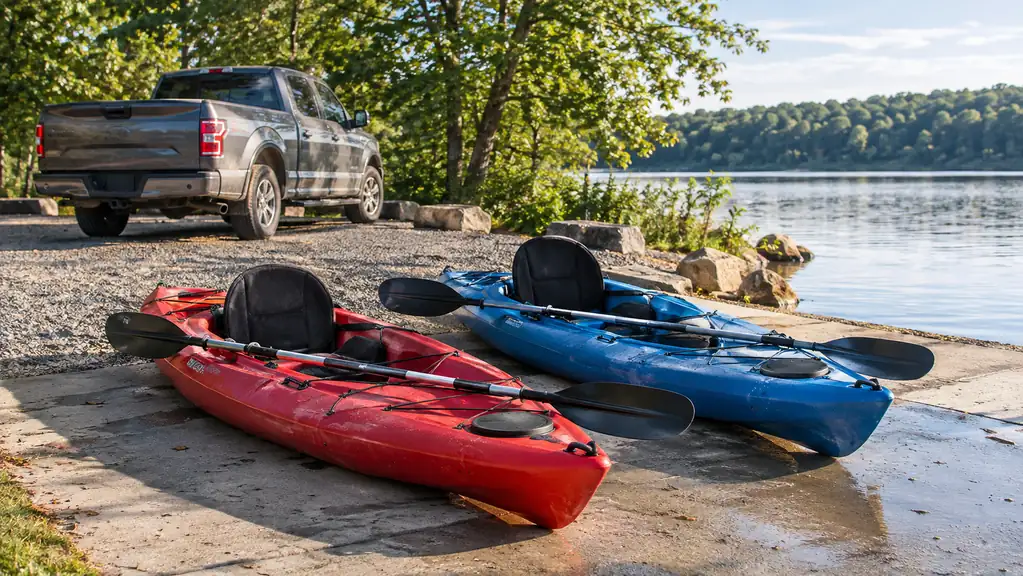
I paddle Claytor Lake and the calm stretch of the New River near Radford, April through October, about twice a month, always in daylight. No ocean, no whitewater, no overnight trips. My kayak is a ten foot sit-on-top that weighs around fifty pounds, and it came off a neighbor's driveway in 2023. The paddle stands in the garage corner in its two sections when it is not in the truck. My husband Ron does not paddle, so every trip I tell him where I am going and when I will be back, and my friend Sheila meets me at the ramp with her own kayak.
I keep the OCEANBROAD on one locking position. I set it the first week I owned it and I have not moved it in twenty months. That is not a criticism of having three positions, it is just the honest truth about how a person like me uses a paddle. My routine is the gravel lot, then a couple hundred yards of gravel and grass, then the concrete ramp, then the water, and then the same thing backwards. I am not adjusting anything mid-trip. I am getting out there and getting back before the afternoon heat.
Most trips I am at the ramp by eight in the morning. Ron gets a kiss on the cheek and a time I will be home, and I load the truck the same way every time: the kayak in the bed with the red flag on the end, the seat and the paddle beside it, the folded cart behind the seat, and the vest and the dry bag on the passenger seat where I cannot forget them. Sheila usually pulls in within ten minutes of me. We are on the water before the ski boats show up, which is the only reason two women in their late fifties get a quiet lake to themselves on a Saturday.
After every trip I rinse it with the garden hose along with everything else and let it dry in the garage. That is the entire maintenance routine. No wax, no oil, no sprays, no repairs. Twenty months of that and it still goes together and comes apart exactly the way it did the first week. For somebody who does not want a hobby that comes with a maintenance schedule, that counts for something.
What It Does Well
The length did more for me than anything else. My old paddle was short enough that I was reaching down and across with every stroke, and my shoulders paid the bill for it. At 230 centimeters I sit up straighter and the blade goes in beside the boat instead of underneath it. Nobody taught me that and I am not an instructor and would not pretend to be one. I just stopped reaching, and my shoulders stopped complaining by the end of the trip. That was the entire change.
The blades hold water. I am not going to throw around words like power, because I paddle at a talking pace and I have no business comparing this to anything a serious paddler would buy. What I can tell you is that the blade goes in and stays put through the stroke rather than slipping sideways. On the flat water I paddle, that is the whole job, and the fiberglass reinforced blades do it without any flex I can feel.
There is one small thing I did not expect to care about. The shaft has a thin tube cover on it, and when my hands are wet from the lake, that cover is the difference between a grip that holds and a grip that slides. I noticed it the first time I reached out to steady the kayak against the ramp with wet hands and then picked the paddle back up. Wet bare metal is slick. Whatever that cover is made of, it is not. It is a small detail, and it is the kind of small detail that shows up in the second hour, not in the first ten minutes.
The two piece design is the other thing I would not give up now that I have it. It comes apart in the middle and both halves go in the truck bed beside the kayak, next to the folded cart and the seat. When I get home it goes back together and stands in the corner. That is a five second job, and it means I am not wrestling a seven and a half foot object around the bed of a pickup with a red flag on the end of the kayak already taking up the room.
And the locking collars have held. That is the part that worries me on any two piece anything. I have had a tent pole collar slip on me and it made for a long night, so I am suspicious by nature. Twenty months of putting this together and taking it apart, twice a month, and I have never had one come loose while I was on the water.
I have used one locking position for twenty months and have not needed the other two. That is not a knock on the paddle. That is what my paddling actually looks like.
Where It Falls Short
The aluminum shaft gets cold. On a chilly April morning at the ramp, before the sun is over the trees, that shaft is the coldest thing I touch all day. My hands are not what they were twenty years ago and I notice it. It warms up once I am moving, and by June it is a non-issue, but if you paddle cold water at the front and back of the season with bare hands, you should know that going in. The PE tube cover helps a little. It does not make the cold go away.
The worst of it was an April trip the first spring I had it, when the sun was still behind the treeline and there was frost in the shaded corner of the gravel lot. I stood there with my hands wrapped around that shaft waiting on Sheila and I felt it in my knuckles, plain as anything. Ten minutes of paddling and my hands were warm enough that I forgot the whole business. That is the honest shape of the complaint: real at the ramp, gone by the first quarter mile. I mention it so it does not surprise you, not to talk you out of the paddle.
It is heavier than Sheila's fiberglass paddle, and I have tried hers for one afternoon on the lake, so I am not guessing. I could feel the difference in my forearms by the time we came in. I am not going to pretend otherwise, because that is exactly the sort of thing people leave out of a review and then you find out the hard way. What I will tell you is that the difference showed up at the end of the day, not in whether I could make the trip. I still paddle the OCEANBROAD every time I go out.
The three locking positions are a feature I have gotten almost no value from. I understand why they exist. If you feather your blades or you switch between paddling styles, you would use them. I do not, and when I did change the position once, out of curiosity, the collar needed a firm hand to seat properly. It is not difficult. It is just not something I want to be fiddling with while the kayak is drifting.
And it is a recreational paddle that lets you know when you ask too much of it. When the wind comes up and I am crossing an open stretch of the lake pushing straight into it, this paddle does not feel like it is doing me any favors. It gets the job done. It just makes sure I know the job is being done. If I paddled open water or long distances I would want something else, and honestly I would want to be a better paddler than I am.
What I Liked
- The 230 cm length fixed my reach and my sore shoulders within two trips
- Breaks into two sections that lie flat in a truck bed, about 47 inches packed
- Locking collars have not slipped once in twenty months of twice a month use
- Fiberglass reinforced blades hold the water without slipping sideways
- Comes with a paddle leash that is genuinely useful when I set it down on the water
- Nothing to maintain beyond a rinse with the hose
Where It Falls Short
- About 2.5 pounds, noticeably heavier than a fiberglass paddle
- The aluminum shaft is cold in the hands on April mornings
- I only ever use one of the three locking positions
- Pushes back when you fight wind across open water
- Not the paddle for long distances or cold water with bare hands
The Paddle It Replaced, and the Fiberglass One I Tried
The paddle that came with my kayak is the reason I know the OCEANBROAD is decent. It was short and heavy and it had me reaching for every stroke, and I gave it back to the neighbor without a second thought. I am not going to pretend I did careful research before I bought the replacement. I read the listing, I looked at the length and the weight and the fact that it came apart in two, and I ordered it. That is how most people in my position buy a paddle, and I would rather tell you that than dress it up.
Sheila's fiberglass paddle is the one comparison I can actually speak to, because I used it for one afternoon and gave it back. It is lighter, and on a warm day with no wind I would rather hold hers. But it cost her a good deal more than mine, and I am on a retired dispatcher's budget where every purchase has to earn its place in the garage. Two and a half pounds is a fair trade for the difference in what we each paid, and I would make the same choice again.
What I would tell somebody standing in the same spot I was standing in two years ago is that the length and the weight are the two numbers that matter and the rest is decoration. I did not know that when I ordered. I got lucky, in that the length I picked fixed the thing that was actually wrong, which was my reach. If you are shorter than five and a half feet, or your kayak is a good deal wider than my ten footer, then 230 centimeters may not be your size, and the listing has the other lengths printed right there for you to check against your own boat.
Who This Is For
This paddle is for the weekend paddler on flat water. Lakes, calm rivers, a couple of trips a month, April through October, daylight only. Somebody who wants one piece of gear that goes together, does its job, rinses off, and stands in the corner until next time. Somebody who is not chasing speed and does not want a lecture from a shop employee about blade shapes. If that sounds like your paddling, the OCEANBROAD will do everything you need it to do, and it has done it for me for twenty months without a single problem.
Who Should Skip It
Skip it if you paddle several times a week, cover real distance, or go out in cold weather with bare hands. Skip it if you have shoulder or back trouble you have actually had looked at, because that is a conversation for your doctor and not for a retired bus dispatcher on the internet. Skip it if you are paddling whitewater, surf, or open water in wind, because this is a recreational paddle and it is honest about that. And skip it if what you really want is the lightest paddle on the rack, because this is not that, and I would rather you hear it from me now.
If your shoulders ache after an hour, start with the length
The 230 cm OCEANBROAD comes apart in two sections, holds the water, and costs about what a tank of gas does. It is the paddle standing in my garage corner right now.
Amazon Check Today's Price on Amazon →