
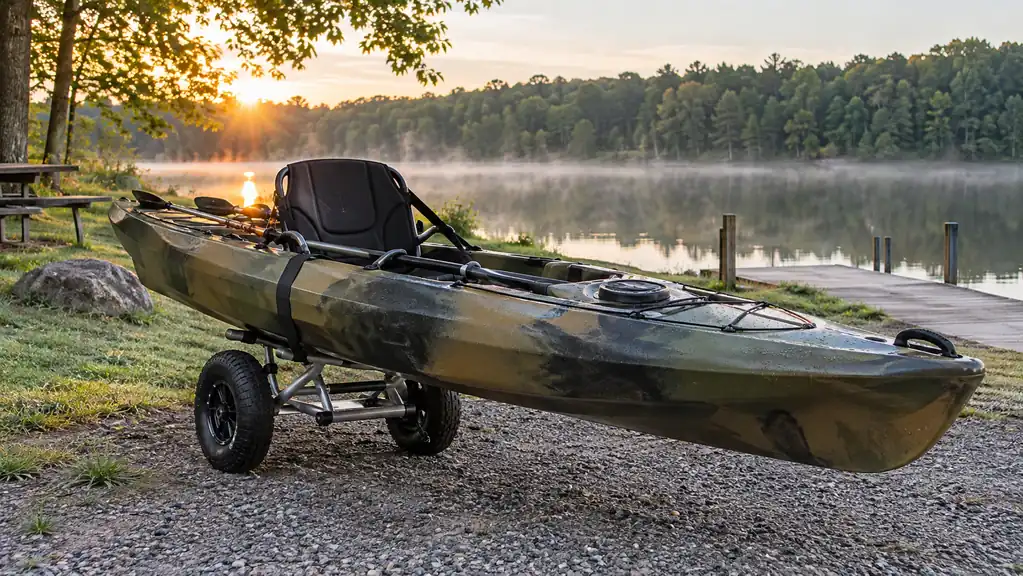
The gravel lot at my lake sits a couple hundred yards above the concrete ramp. That is not a long walk. It is a long walk with fifty pounds of sit-on-top kayak in your hands, half of it on loose rock that shifts under your shoes. For three seasons I did it the hard way, one hand on the bow handle, kayak dragging through the grass, back already tightening before I got wet. I tried a few things first. I wrapped an old towel around the bow handle to soften the grip, which helped my hand and did nothing for my shoulder. I tried dragging it by the stern so the nose lifted, and the nose just plowed into the gravel instead. In April 2026 I bought a folding Bonnlo cart with my own money. Here are ten reasons it earned its spot in the truck bed.
These are not gear magazine reasons. They are the things I notice every trip, about twice a month from April through October.
Stop carrying fifty pounds down a gravel hill
Folding aluminum frame, solid airless PU tires, 200 pound capacity, about 5 pounds to lift. Folds flat behind the truck seat.
Amazon Check Today's Price on Amazon →The gravel walk stops deciding your trip
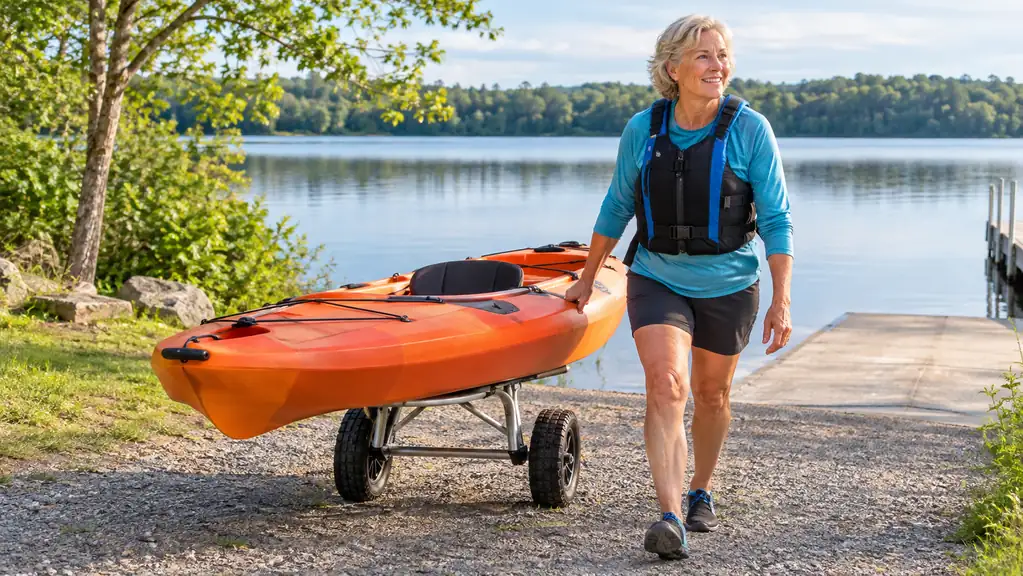
My launch has a gravel lot and a couple hundred yards of path, part gravel and part grass, ending at a concrete ramp. On foot that is nothing. With a kayak on your shoulder it is the part of the morning I used to dread. I set the kayak on the Bonnlo cart in the parking lot, strap it down, and walk. Same walk, same hill, entirely different mood when I reach the water. The last stretch before the ramp is the worst of it, a wash of loose stone where the gravel has pushed downhill over the years. That is the piece that used to make me stop and set the kayak down twice. Now I just slow my steps and keep rolling.
Fifty pounds comes off your back and shoulders
My sit-on-top weighs about 50 pounds. Carrying it by the bow handle puts all of that through one wrist, one shoulder and the small of your back, and the stiffness shows up before lunch. On the cart the weight goes into two solid tires and an aluminum frame. I still lift the kayak onto it. That is one lift in the parking lot instead of one long strain down a hill. The difference I notice most is on the drive home. When I carried it, I would sit in the truck for a minute before turning the key, waiting for my lower back to unclench. Most trips now I start the engine and go.
You stop needing a second person at the ramp
Sheila is 60 and paddles with me most trips, and for three seasons the two of us did the awkward two person carry. Somebody takes the bow and somebody takes the stern and you both walk sideways like a piece of furniture. She is happy to help, but she is not always free, and I do not like needing her to get my own boat to the water. The Saturday she had a granddaughter's birthday party and I wanted to go anyway, that was the trip that made up my mind. I stayed home instead. I have not had to make that trade since April.
It folds down and rides behind the truck seat
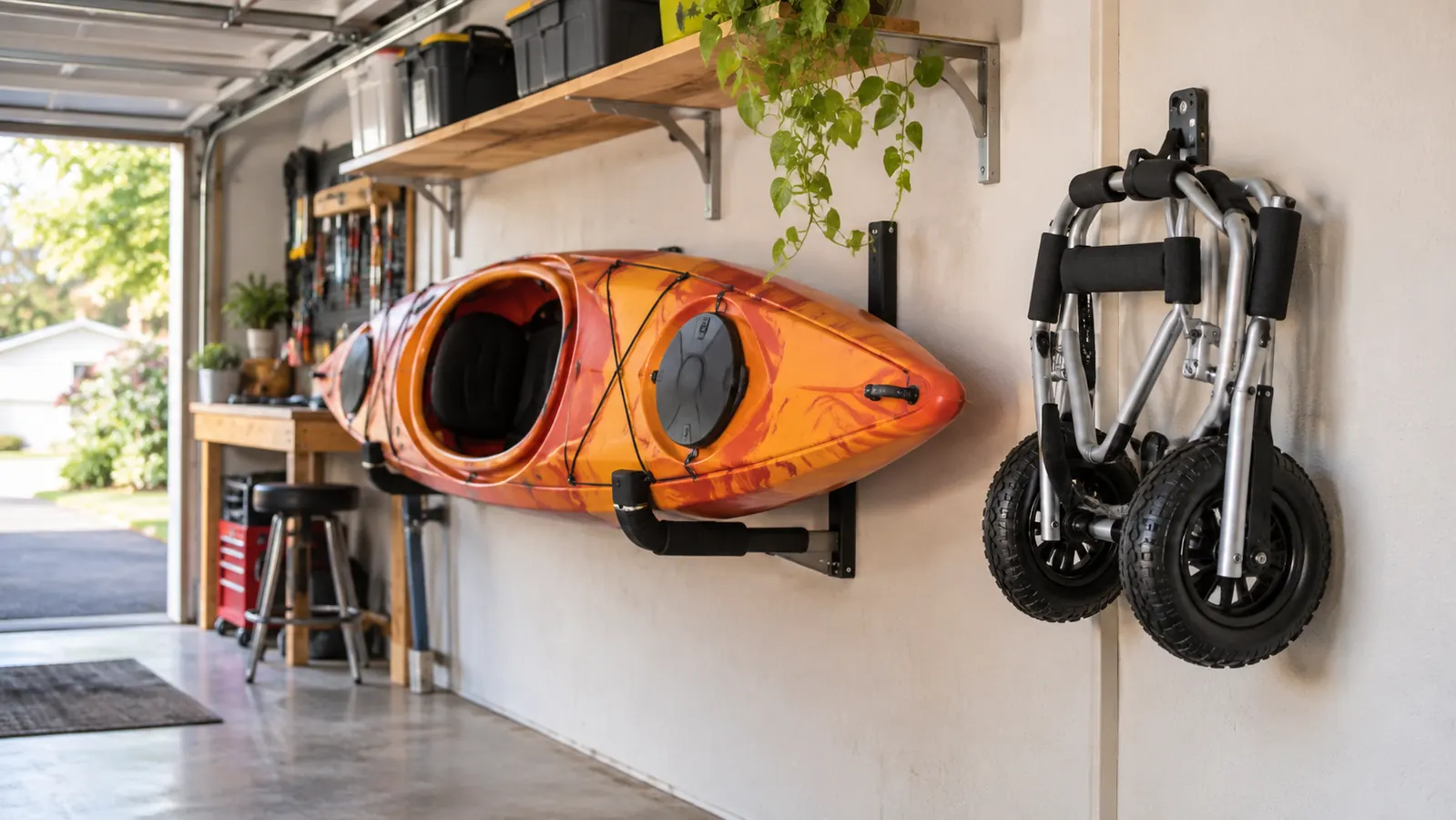
The cart folds. Mine hangs on a hook beside the kayak in the garage, and on trip days it goes behind the seat of my Tacoma with room to spare. That matters more than it sounds. Gear that is a nuisance to store becomes gear you leave at home. This folds flat enough that I have never had to make that choice on a Saturday morning. My packing order has not changed much either: seat and paddle in the bed beside the kayak, the folded cart behind the seat, vest and dry bag on the passenger seat. It slots into a routine I already had.
Solid tires mean no flat to fix at the ramp
The tires are solid PU, 10 inches across and 3 inches wide, airless by design. No valve, no pump, no slow leak that shows up when you are already running late. I have had zero flat tires in seven months of gravel and grass. I am not a person who wants to be changing a tire in a gravel lot at eight in the morning. I keep a small hand pump in the truck anyway, because I keep one for the truck tires, and it has never once come out for the cart.
I set the kayak on it in the parking lot and roll the whole thing down to the ramp by myself. That is the entire trick.
Two ratchet straps come in the box
The cart ships with two ratchet straps. I used them for the first few trips before switching to a cam strap I already owned, which is just quicker for my hands. Either way works. What I like is that nothing extra had to be ordered. The straps were in the box, the Bonnlo cart was ready, and I was on the water the same weekend I opened it. The cam strap I use now runs across the middle of the kayak and hooks to the frame on both sides. One pull and it is snug.
The 200 pound limit leaves room to spare
The cart is rated to 200 pounds. My kayak is about a quarter of that. I am not hauling anywhere near the limit, which is how I like my equipment. It means the frame is not working hard, the wheels are not working hard, and I am not listening for a creak the whole way down the hill. If you paddle a heavier fishing setup with a motor mount and a crate, you are still well inside what this is built to carry.
About 5 pounds of aluminum, carried with one hand
Aluminum frame, about 5 pounds. I take it down from the garage hook with one hand and set it in the truck bed beside the kayak. If I had to carry it a quarter mile I could. That is the difference between a tool you use and a tool you resent and leave in the garage. It also means that when I get to the ramp and slide the kayak off, I can pick the cart up, walk it back to the truck and be done, instead of leaving it on the bank and hoping it is there when I come in.
Loading alone in the parking lot becomes normal
The first trip I did alone I expected to fumble. I put the kayak on the cart in the parking lot, strapped it, walked it down, slid it off at the ramp, and carried the cart back up to the truck. Nobody held anything. I will be straight with you: if the kayak is not centered, the cart wants to lean. I check that before I start walking. Centered, it rolls straight. My habit now is to set it down, step back, look at both sides, nudge it an inch one way or the other, and only then pull the strap tight.
It keeps you on the water in the years you might have quit
I am 58. My lower back and shoulders are ordinary for 58 and I would like them to stay that way. The Bonnlo cart is not a medical device and it did not fix anything. What it did was take away the one part of kayaking that had me thinking about staying home. The walk is not what decides my Saturday anymore.
What I'd Skip
Two honest drawbacks. The tires are solid, so gravel jolts straight up through the frame. It is not painful, but it is not smooth either, and on the roughest stretch I slow down. Second, a cart like the Bonnlo is only as good as your loading. If the kayak sits off center it leans and wants to tip, and walking carefully does not fix that. Center it, strap it, then go. I would also skip the cart entirely if you launch where you park, or if you always paddle with someone who takes the other end and you do not mind the carry. And if you have a real back or shoulder problem, ask a doctor before you take on hauling anything, cart or not.
Seven months in, it still goes in the truck every trip
Solid tires, aluminum frame, 200 pound limit, folds flat. One lift in the parking lot instead of a long strain down the hill.
Amazon See Today's Price on Amazon →