
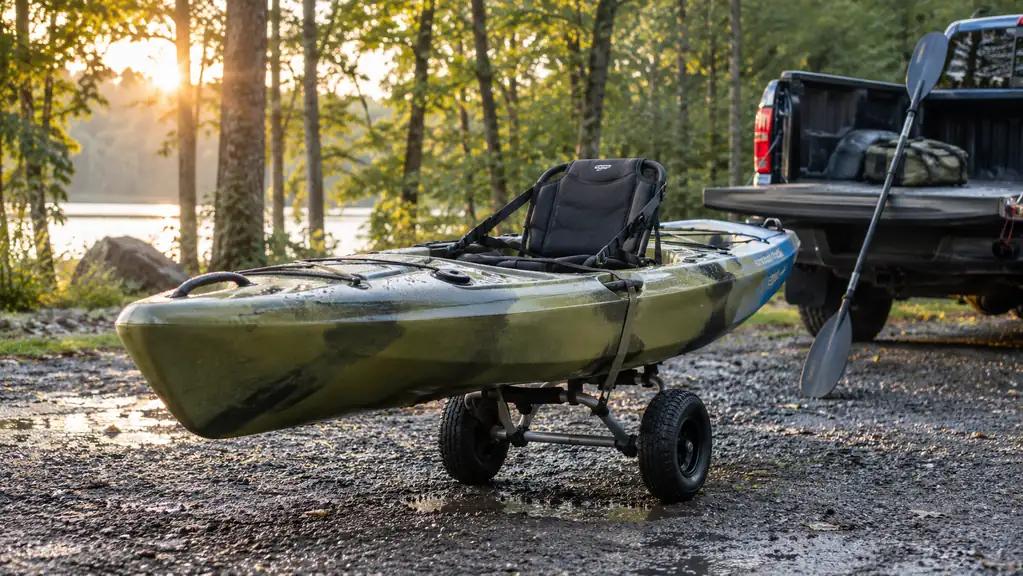
The walk from the gravel lot down to the concrete ramp at Claytor Lake is a couple hundred yards. Part gravel, part grass, ending at the ramp. For three summers I made that walk dragging my 10 foot sit-on-top by the bow handle, stopping twice to switch hands. It weighs about 50 pounds. By the time I reached the water my lower back had already told me what it thought of the plan, and the paddle had not touched water yet. That is what pushed me to the Bonnlo kayak cart. I bought it in April 2026 with my own money, and I have used it on every trip since.
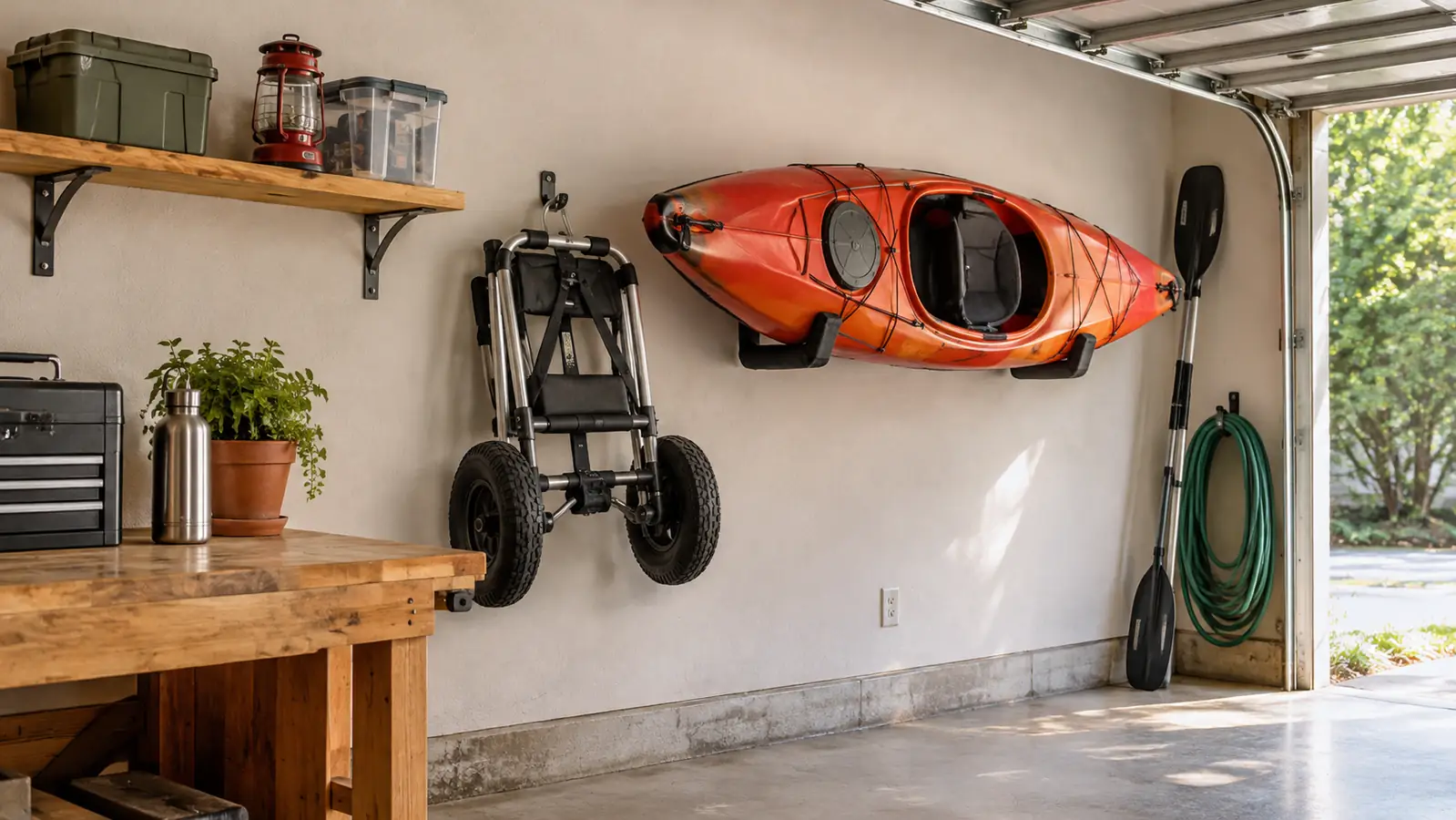
I had tried the other things first. For a while I just waited for Sheila to take the other end, which meant my launch happened on her schedule and not mine. On the days she could not come, I dragged it. When I dragged it, I took the long way around through the grass because the gravel hurt my hands more than my back did. It was a small, silly problem that made me think twice before going, and thinking twice is how a person slowly stops going. The cart hangs folded on a hook in my garage now. I do not think about the walk anymore. That is the whole review in one sentence, and everything below is the detail.
The Quick Verdict
It does the one job I bought it for and it does it alone, without a partner on the other end and without a sore back. The solid tires jolt over gravel and the kayak has to sit centered, but neither has kept me from using it on every trip since April.
Amazon Check Today's Price →The walk from the lot to the ramp is the part that wears you out. This rolls it.
Foldable aluminum frame, a 200 pound limit, solid 10 inch tires that will not go flat sitting in a hot garage, and two ratchet straps in the box.
Amazon Check Today's Price on Amazon →How I've Used It
Nothing about my routine changed except the walk. The cart rides folded behind the truck seat. I back the Tacoma up to the edge of the lot, put my vest on first like always, then set the kayak down onto the cart, run a strap over the deck, and roll it down. One trip down and one trip back up. Two trips a month from April through October, fresh water only, daylight only. Ron knows where I am and when I expect to be back, same as always.
The first trip with it was the second week of April, a cold gray Saturday with the wind coming across the water. I made a mess of it. I set the kayak too far back, walked about ten feet, felt the nose lift, and set it down again. Then I put it too far forward and the tail dragged on the concrete. The third try was the one. The balance point is roughly where the seat sits on my kayak, a little behind the middle of the hull, and once I found that I stopped thinking about it. I still remember standing at the top of that ramp with the kayak sitting level on the cart and nobody waiting on me, and thinking this was the first spring I had not needed to call anybody.
The Bonnlo cart is a simple thing, which is most of why I like it. A foldable aluminum frame, two wheels, and a pair of ratchet straps that come in the box. It weighs 5 pounds. The listing puts the tubing at 20 by 2 mm, anodized, with a 200 pound weight limit, and my kayak is about 50 pounds, so there is room to spare. The tires are solid polyurethane, 10 inches across and 3 inches wide. No tube, no valve, no air. I have had a wheelbarrow tire go soft in a hot garage and I did not want a second version of that argument in my life.
It folds down flat enough to sit behind the seat of a pickup. I have never taken it apart, never oiled it, never tightened anything on it. It gets hosed off with the rest of the gear when I get home and it hangs on its hook until the next trip.
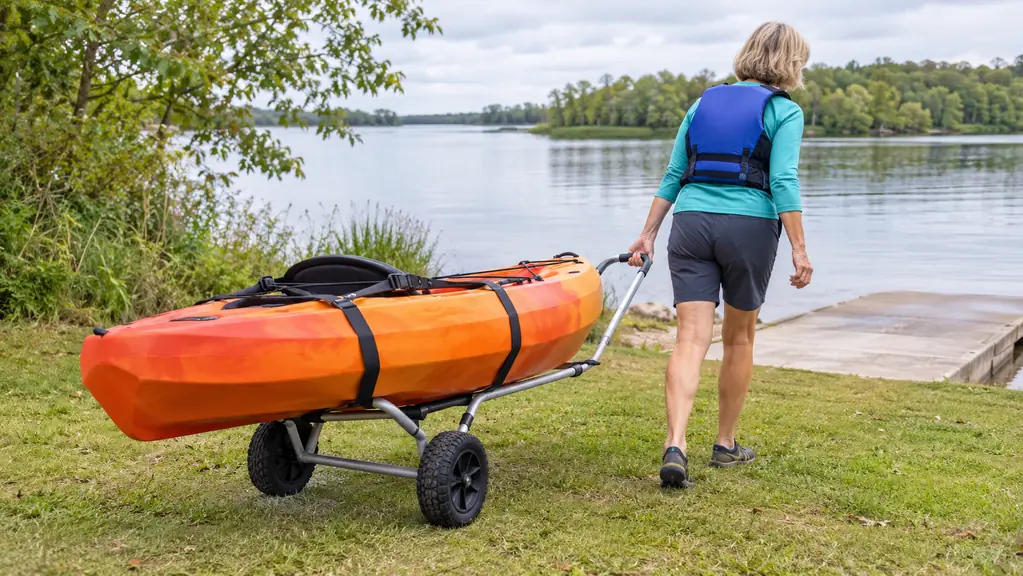
At the bottom of the ramp I take the strap off first, then slide the kayak off the cart and hold it by the bow while I set the cart aside. The cart folds and goes back against the grass at the edge of the concrete, out of the way. Coming in during the afternoon I do it in reverse. Kayak up on the cart, strap over the hull, walk it up. If the ramp is busy I wait, which is a small price. Nobody has ever complained about me taking two minutes at the bottom of a launch, and I would rather be slow than be the person who blocks the ramp on a Saturday.
Setting It Up in the Parking Lot
There is no assembly routine to learn. The frame opens, the wheels go on the axle ends, and it stands there. The first time took me longer than it should have because I was being careful and reading the box. Now it is a thirty second job at the tailgate. I do it before I put the vest on, so the vest is not in my way when I have to bend down.
I practiced once in the garage before I ever took it to the lake, which sounds silly and was not. I opened it on the concrete, put the wheels on, set the kayak on it, and rolled it from one end of the garage to the other about six times. Ron watched from the door and said nothing, which is his way. What that practice run taught me is that the cart steers from the top of the frame rather than from the wheels, so you move the whole thing instead of trying to aim a wheel like a shopping cart. Small thing. It made the first real trip a lot less clumsy.
Loading is the part worth talking about. You lift the bow, set it on the frame, and slide it forward until the balance point sits over the axle. My kayak has four strap points on the deck for the seat, and I run my cam strap over the hull behind the seat and down to the frame. The cart ships with two ratchet straps and they work fine, but the cam strap I already owned is one motion and I reach for it out of habit. The ratchet straps stay coiled behind the seat as spares, and I have not needed them yet.
Here is the honest part. If the kayak is not centered, the whole thing wants to lean. It does not fall over. It leans, and you feel it in your wrist before you see it with your eyes. That took me three or four trips to sort out. Now I know where the hull sits level by feel, and it is one look instead of two. Nobody warned me about that and I would rather you hear it from me.
Gravel, Grass, and the Concrete Ramp
The lot is gravel and the first stretch is loose and uneven. This is where the solid tires earn their keep and also where they complain. Polyurethane does not absorb much. You feel every rock come up through the frame, and the cart chatters along at whatever pace you walk. It is not painful. It is loud and busy. On the grass stretch it goes quiet and rolls easy. On the concrete ramp at the bottom it is smooth as anything you could ask for.
There is a stretch in June where the county grades the gravel and it goes loose and deep for a couple of weeks. That is the worst it gets. The wheels sink an inch and the cart wants to walk sideways in the loose stuff. I go slower, I pick the packed edge of the lane where the truck tires have been, and I hold the frame with both hands instead of one. Ten extra seconds, no drama. The grass at the bottom is the opposite. After a rain it is soft and the wheels roll quiet, and that is the part I actually enjoy.
The trade is worth it to me. An air tire would ride softer over that gravel. It would also be flat in my garage by July, because I am not the person who checks tire pressure before a Saturday paddle. I will take the chatter and skip the pump.
Seven months in, the Bonnlo cart's wheels have not developed a flat spot, the frame has not loosened, and nothing has rusted. It gets hosed down with everything else after every trip and dries on the hook in the garage. No wax, no lubricant, no spray, no repairs. Nothing has needed any.
One thing I figured out in May that nobody told me. Coming back up the ramp with an empty kayak, turn the cart around and push instead of pulling. Pushing is easier on my shoulders than dragging is, and on the grass stretch it is easier on everything. That is the only technique I have picked up, and it took me a month to notice it.
Fifty pounds of kayak, a couple hundred yards of gravel and grass, and I do it in one trip now, by myself, without stopping to switch hands.
The Two Things That Still Bother Me
First, the leaning. It is a balance issue, not a defect, but a new owner should hear it up front. Load it dead center and it is stable. Load it two inches off and it leans. On a side slope in loose gravel you will feel it in your wrist the whole way down. My lot is mostly level. If yours is not, walk on the uphill side of the cart and you will be fine.
Second, there is no good place to put the tail of the strap. It wants to drag on the ground. I tuck mine under the deck line and it stays put, but that is a workaround, not a design. I also loop a hair tie around the extra length and hook it over the frame, which is not in the manual and has held for months. Small thing. It is the kind of small thing that annoys you every single trip if you do not solve it.
That is the whole list. Seven months on the water and that is the whole list.
What I Compared It To
Carrying by hand is the alternative I actually lived with, so it is the one I can speak to. Alone, by the bow handle, it is two stops and a sore back. With Sheila on the other end it is easy, and it also means I go when she goes and not when I want to. The cart replaced both of those, and it replaced them for good.
The last time I did it by hand was a Saturday in October 2025, before the cart, and I remember it because I quit early. I got the kayak down to the water in three stops, launched, paddled for maybe forty minutes, and then sat in the boat at the ramp thinking about the walk back up instead of the water. That is a bad trade. I paddled less because I was dreading the carry. When I got home I got on the computer and ordered the Bonnlo cart that night.
I thought about strapping the kayak to the small hand truck I keep in the garage. The hand truck is taller than the kayak is wide and the bed is a flat plate, so the hull would be balanced on an edge the whole way down. I never tried it and I am not sorry about that.
I did not consider a roof rack. I cannot lift 50 pounds over my head safely at 58 and I am not going to pretend otherwise. That is not a knock on roof racks. It is just the truth about my shoulders. The cart keeps the kayak at waist height from the tailgate to the water, and that is the whole reason I bought it.
What I Liked
- Rolls a 50 pound kayak down a couple hundred yards of gravel and grass in one trip, alone
- Solid polyurethane tires, 10 by 3 inches, so there is no tube to go flat in a hot garage
- Folds flat enough to ride behind the seat of a pickup
- Anodized aluminum frame at 5 pounds with a 200 pound limit, well past what a recreational kayak needs
- Two ratchet straps come in the box
- Seven months of hosing off with no rust, no flats and nothing to tighten
Where It Falls Short
- Solid tires jolt and chatter over loose gravel
- Wants to lean if the kayak is not centered over the axle
- No place to secure the strap tail, so it drags unless you tuck it
- The listing's warranty line just points you back to the seller
Who This Is For
If you paddle alone, this is the piece of gear that changes your Saturday. If you are past 50 with the ordinary stiff back that comes with it, or if your launch is a real walk instead of a two car driveway, the Bonnlo cart does the one job that used to make you think twice. It is also for the person who hauls a kayak in a pickup bed and does not want a rack. Fold it, hang it, forget it.
I am 5 foot 5 and 58 years old, and I get a 50 pound kayak from the tailgate to the ramp by myself now, which I could not say a year ago. What surprises me is that the walk stopped being a decision. Before, I would look at the weather and then look at the lot in my head and sometimes talk myself out of a Saturday. Now I load up because there is nothing to dread. That is worth more than the thing cost, and I say that as somebody who counts carefully.
Who Should Skip It
If your launch is ten feet of pavement, you do not need this and I would not spend the money. If you always have a partner who is happy to take the other end, you already have a cart. And if your back or shoulder problem is a real diagnosis and not the ordinary stiffness I have, ask your doctor before you start hauling anything. A cart makes a walk easier. It does not fix a body.
Seven months, two trips a month, and I still have not carried it by the handle.
If the walk from the lot to the water is the reason you paddle less than you want to, this is the simplest way I know to get that back.
Amazon Check Today's Price on Amazon →