
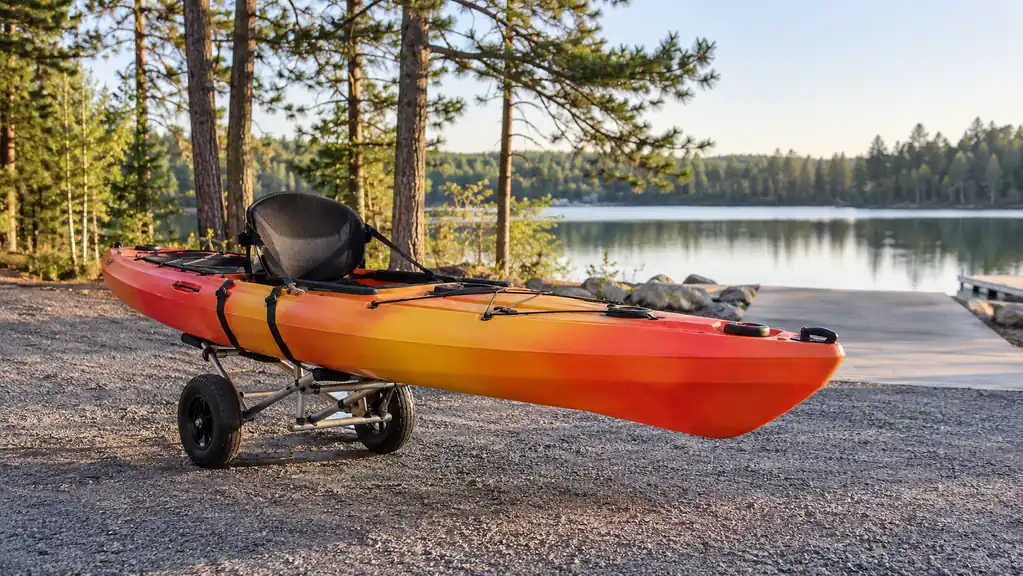
I carried my kayak by hand for three years before I bought a cart. It is a used 10 foot sit-on-top, right around 50 pounds, and it rides in the bed of my Tacoma with a red flag on the end of it. Getting it to the water meant dragging it by the bow handle across a gravel parking lot, along a strip of grass, and down onto the concrete ramp at Claytor Lake. A couple hundred yards each way, twice a trip. On the days my friend Sheila came along she took the other end and it was fine. On the days she did not, it was not fine at all.
The Bonnlo kayak cart came in April 2026, seven months ago, and I want to be straight with you about what it did and did not change. It did not make carrying by hand obsolete. It made it optional. The cart is clearly better for the long walk down to the water, and it is clearly worse for almost everything that happens before and after that walk. Carrying by hand is still the right answer at a short, flat, two person launch. So this is not a comparison where one side takes every round.
Here is the short answer. Buy the Bonnlo if you paddle alone more than half the time, if your walk from the truck to the water runs longer than about fifty yards, or if your back and shoulders are the part of you that complains the next morning. Keep carrying by hand if you almost always paddle with someone, if the water is twenty steps from where you park, or if the drag honestly does not bother you. I am 58 with the ordinary stiffness that comes with it, and it bothered me plenty.
| Bonnlo Kayak Cart | Carrying by Hand | |
|---|---|---|
| Getting to the ramp alone | Rolls the whole way, both hands on the kayak, one trip | Drag by the bow handle, stop twice to rest, then walk back for gear |
| Setup at the truck | Unfold the frame, center the kayak, run a strap over the deck and cinch it | Grab the handle |
| Gravel and soft grass | Solid tires jolt over loose rock, and the kayak tips if it is not centered | No wheels to fight, easy over the rough strip |
| Back and shoulders the next morning | Nothing to show for the walk | Stiff and sore by the time the kayak is in the water |
| Two paddlers, one kayak | Still a one person job, the second person just walks alongside | Three minutes with one on each end |
| Storage in the garage | Folds down and hangs on a hook beside the kayak | Nothing to store, nothing to keep track of |
| Tires and upkeep | Solid PU tires, 10 inch by 3 inch, no air to check | Nothing to maintain because there is nothing to own |
| What it will haul | Rated to 200 pounds, so kayaks, canoes and paddle boards | Whatever you and a friend can lift |
What the Bonnlo Cart Actually Changes About the Walk
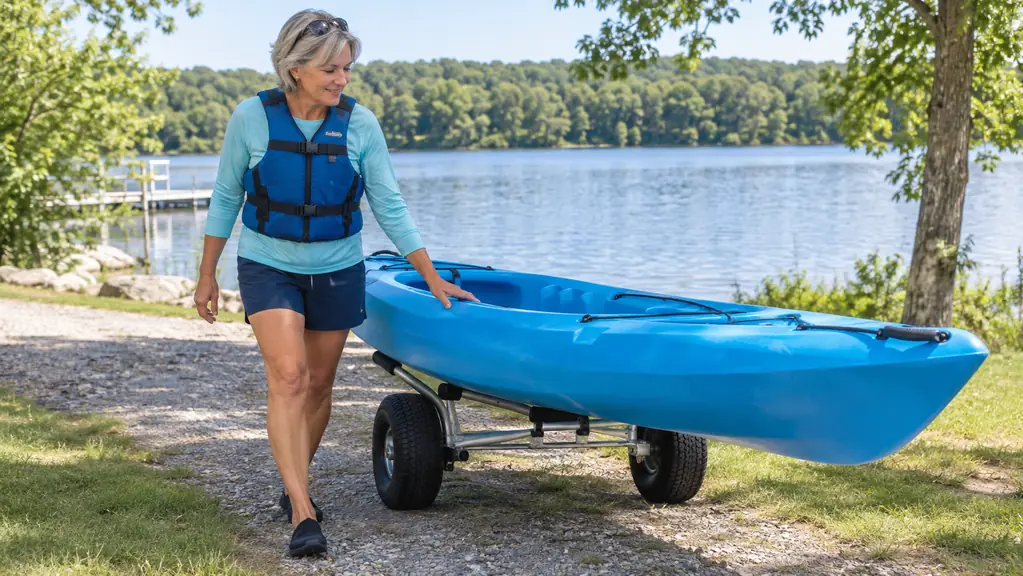
The walk does not get shorter. That is the first thing to understand, and I think it is where people expect too much from a cart. What changes is how much of that walk you spend holding fifty pounds off the ground. In the parking lot I unfold the frame, set the kayak on it, center it, run a strap over the deck and cinch it down. Then I tip the whole thing back and roll. Both hands stay on the kayak. My arms hang instead of pull. The gravel still crunches under the tires and the ramp is still at the far end, but I get there with something left.
The hardware, for anyone who wants the details. The frame is aluminum and it folds down flat, so on the way out it rides behind the seat of the truck and at home it hangs folded on a hook in the garage beside the kayak. The tires are solid PU, 10 inches across and 3 inches wide, which means there is no air to check and nothing to pump on a Saturday morning before an early start. The whole cart weighs about five pounds. It is rated to 200 pounds, roughly four times what my kayak weighs, and that same rating covers a canoe or a paddle board if your garage holds more than one boat. It ships with two ratchet straps. I use a cam strap I already owned instead, because my hands know that one and the strap is not the hard part.
What it does not do, and this matters. It does not carry the kayak the last ten feet into the water. I still lift it off the frame, set it on the ramp and slide it in, and I still walk back up for the paddle and the seat and the dry bag. It does not set itself up, which is the whole subject of a later section. And it does not help at all on the day I leave it sitting in the truck because I am late and the lake is right there.
Where the Bonnlo Cart Wins
Ron does not paddle. He stays home, and I tell him where I am going and when I will be back, every trip. That means I am on my own a good half of the time, and on those trips the cart is not a convenience. It is the reason the trip happens. Before, dragging the kayak by its bow handle meant stopping twice on the gravel to set it down and shake out my arm, and by the time I reached the ramp I had already used up the good part of my morning. Now I make one trip with both hands on the kayak, come back for the rest of my gear, and get on the water still feeling like a person.
The other thing it wins is my back and shoulders, and I want to be careful how I say that. I never saw a doctor about the stiffness. I do not have a diagnosis, and I am not going to pretend that a folded aluminum frame with tires on it treats anything. What I will tell you is that I used to notice my lower back and shoulders for the rest of the day after a solo trip, and now I do not notice them at all. The stiffness is still there after two hours of paddling, which is a different thing entirely. It just is not there from the parking lot anymore.
The last win is one I did not see coming. I set the paddle and the dry bag on top of the kayak and strap the whole load down together, so the walk is one trip instead of two. That is the change I notice most, more than my arm. On a July morning with the ramp already busy and the sun up over the trees, one trip matters.
Where Carrying by Hand Wins
Setup. Every single trip I unfold the frame, set the kayak on it, center it, run the strap over the deck and cinch it. Two minutes if the wind is not blowing and I am not in a hurry. Carrying by hand takes no time at all, because there is nothing to set up. At a launch where the water is close, or on a weekday evening when I am already running behind, the cart is more work than the carry. I have left it sitting in the truck bed for exactly that reason.
Two people. When Sheila comes with me we carry the kayak together, one on each end, roughly three minutes from the truck to the ramp, no assembly and nothing to fold up afterward. Neither of us is doing more than half the work, and it is honestly easier than rolling it. The cart sits that one out, and I am not sorry about it.
And the gravel. This is where the cart is at its worst. Solid tires do not give, so a loose rock sends a jolt straight up through the frame and into the hull. If the kayak is not sitting dead center on the frame it wants to tip toward the heavy side, and I have stopped halfway more than once to pull it straight and start again. It is also one more object in my life. It folds flat and hangs on a hook, which is tidy enough, but it is still a thing I have to remember, load, unload and store. Carrying by hand requires nothing but a handle you already own.
I still lift the kayak off the frame at the ramp and slide it in. What I stopped doing is dragging it two hundred yards first.
Half your trips are solo. This is the gear for those trips.
Folds down flat, hangs on a hook in the garage, rated to 200 pounds, and the solid PU tires need nothing from you before an early start. It ships with two ratchet straps. Mine has hung on that hook since April and I have not had to think about it once.
Amazon Check Today's Price on Amazon →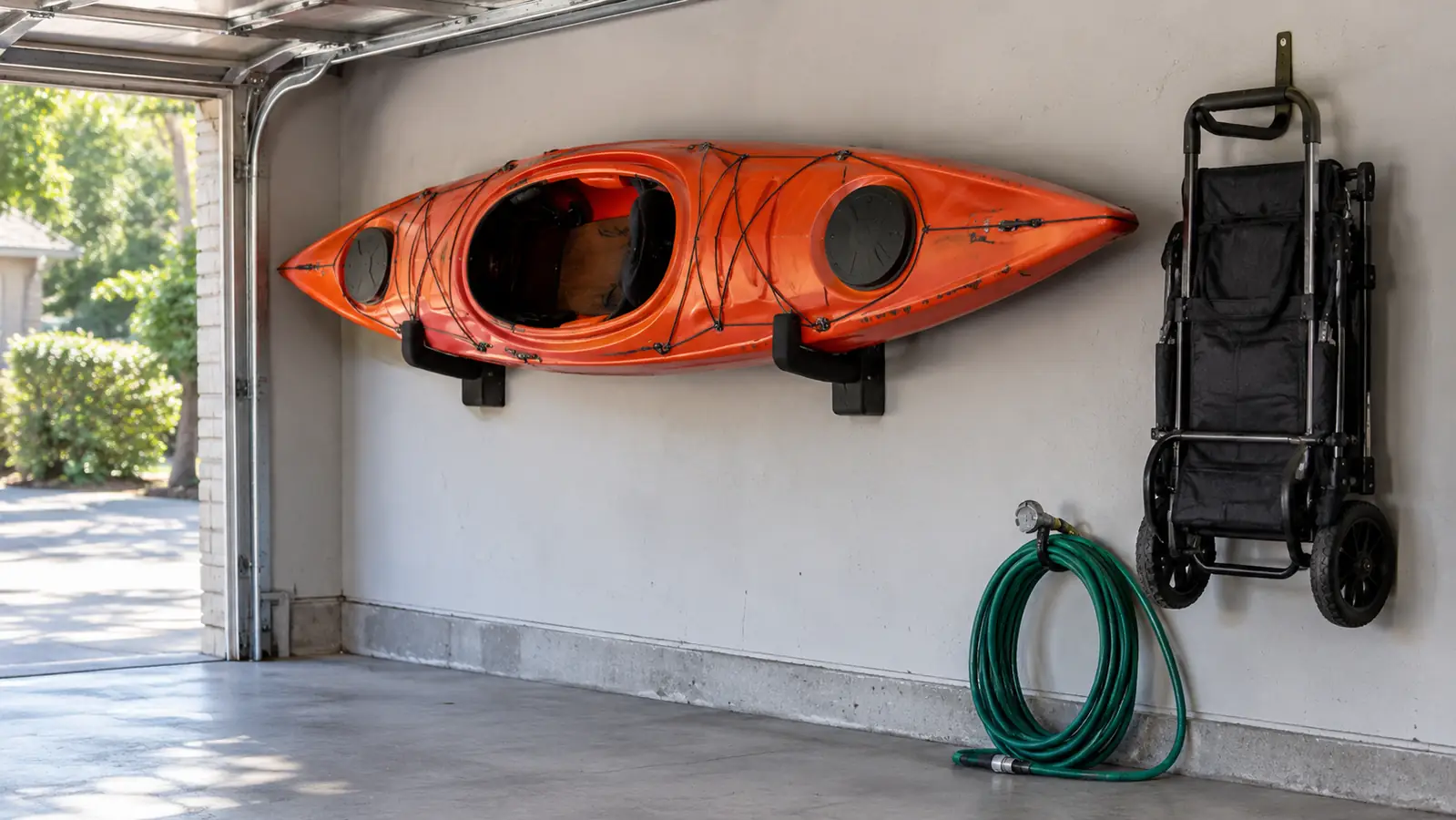
The Walk Back, Which Nobody Talks About
Everyone thinks about getting the kayak down to the water. Nobody thinks about the other direction, which happens at the end of the day when your arms are tired, the lot has filled up, and the sun has dropped behind the trees. Coming back, the kayak is wet and it feels heavier than it did at eight in the morning. Dragging it up the ramp by the bow handle with wet hands used to be the worst five minutes of the whole day for me, and it is the reason I skipped a lot of evening trips I could have taken.
Now I roll it up the ramp, unstrap it, tip it into the truck bed and drive home. The cam strap across the deck is the one thing that needs a little feel. Too loose and the kayak shifts on the frame. Cranked down hard and it wants to slide off sideways on any kind of slope. Two fingers of tension is about right, and it took me a few outings to learn that. That is the entire learning curve, as far as I can tell.
Who Should Buy Which
Buy the Bonnlo cart if any of this sounds like your launch. You paddle alone more than half the time. Your walk from the truck to the water runs longer than about fifty yards, or it is gravel, or it has a slope in it. Your lower back or your shoulders are the part of you that ends the day sore. You can lift your own kayak off the ground without help, but you would rather not do it every time you want to go paddling. That was me, and it was worth the shelf space.
Keep carrying by hand if you almost always paddle with a partner, if the water is close to where you park, if your kayak is light enough that you forget you are carrying it, or if you simply do not mind the drag. There is no shame in any of that, and a cart hanging in the garage that you never use is worse than no cart at all. There is a middle ground too, and it is where I live. I roll the cart on the days I am alone and I leave it in the truck on the days Sheila comes. Matching the tool to the day is not a compromise.
What I Liked
- Rolls the whole walk solo with both hands on the kayak
- Folds flat and hangs on a hook beside the kayak
- Solid PU tires, 10 inch by 3 inch, so no air to check
- About five pounds and rated to 200 pounds
- Ships with two ratchet straps
Where It Falls Short
- Solid tires jolt hard over loose gravel
- Wants to tip if the kayak is not centered on the frame
- Two minutes of assembly and strapping every trip
- One more object to load, store and remember
Decide it once, before the next walk down.
You already know how the walk feels at your launch. If it is the part of the day you dread, this is the simplest fix in kayaking that does not involve asking a friend for help. If it is not, keep carrying and put your money toward a better paddle instead.
Amazon Check Today's Price on Amazon →