

For a long time, my lower back decided how far I paddled. I am 58, and I paddle a used 10 foot sit-on-top kayak on Claytor Lake and the calm stretch of the New River near Radford. The kayak came with a bare molded seat. I put a folded foam garden kneeling pad on it and told myself that was enough. It was not. After about an hour, my lower back got stiff, and I turned around for the ramp. Not because I was in agony. Because I was done.
I tried the usual things first. I shifted my weight. I stopped and stood up in the shallows. I sat farther forward. I let the pad dry out and put it back. None of it changed the hour mark. What changed it was the setup. In August 2025 I bought a Pactrade Marine padded kayak seat with a backrest and cushion, and I clipped it to the four strap points on the deck of my kayak. The seat did not make my back young again. It made the hour mark stop being the end of the trip. That is the honest version.
If your back pain is more than ordinary stiffness, talk to a doctor. I am not an instructor, a guide or a physical therapist. I am a retired county school bus dispatcher who wants to stay on the water a little longer. The steps below are what I do with my own gear, in my own kayak, on flat fresh water.
The hour mark stopped being the end of my trip
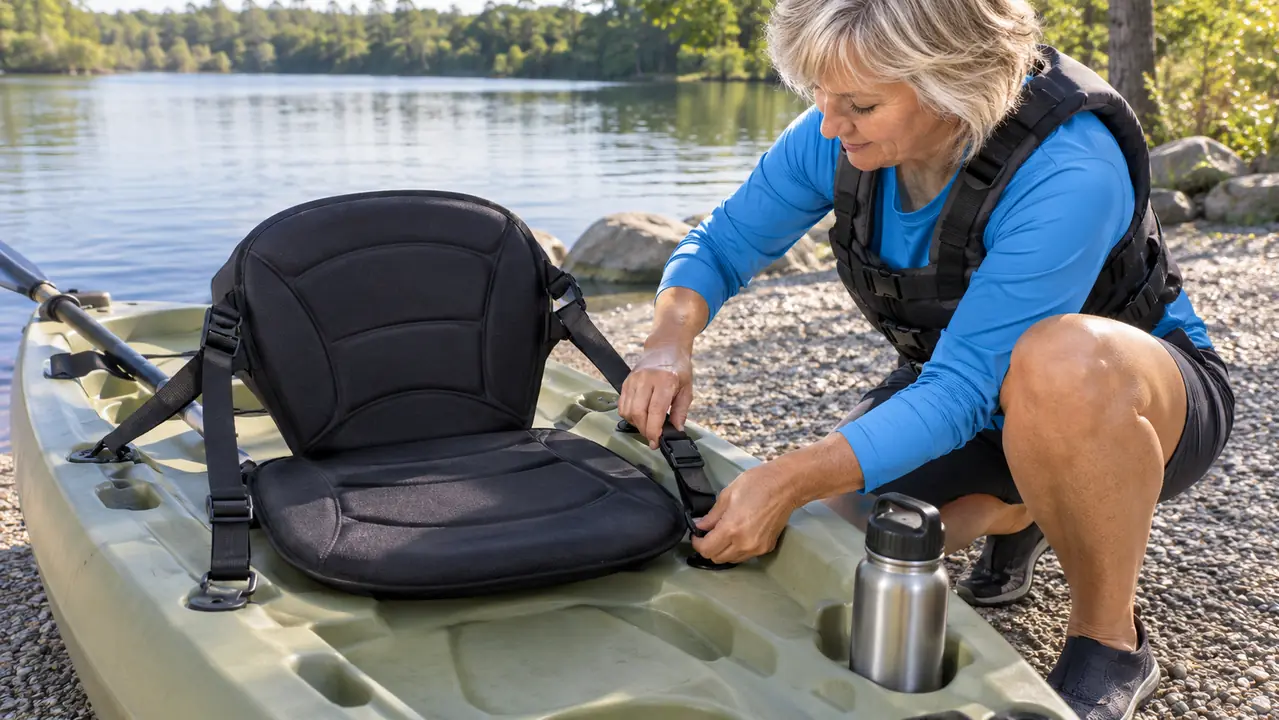
The Pactrade Marine padded kayak seat has a backrest, a cushion and four adjustable webbing straps. I clip it to the four deck strap points on my sit-on-top, set the cushion under me and tighten the backrest until it supports my lower back without pushing me forward.
Amazon Check today's price on Amazon →Five Steps That Made the Difference
Step 1: Replace the seat that is not supporting you
The first step is the least fun one. Stop pretending the bare molded seat is fine. Mine was not. A folded garden kneeling pad gave me a little cushion, but it did nothing behind my lower back. The Pactrade Marine seat has a padded backrest and a padded cushion, and it weighs about 3.4 pounds. The seat is listed at 15.74 inches wide and 12.59 inches deep. Those numbers matter because the seat needs to sit under you, not behind you like a camp chair.
I put the cushion on the deck so the front edge sat just behind my knees. If the front edge presses behind your knees, you will push back against the backrest to get comfortable, and that is the opposite of what you want. The backrest should meet your lower back, not the middle of your shoulder blades. With the seat in place, I had something to lean into instead of something to brace against.
I am not saying every paddler needs the same seat. I am saying a seat with a backrest is a different tool than a foam pad. The Pactrade Marine seat was the first one I bought, and I bought it with my own money on Amazon, one item at a time. I did not buy a second seat to compare. I made this one work.
Step 2: Set the seat depth before you tighten anything
Before I connect the straps, I set the seat where I want it. I want the cushion under my sit bones and the backrest low enough to support my lower back. If the seat is too far back, I slide forward and the backrest ends up behind me doing nothing. If it is too far forward, the front edge digs in behind my knees. I move it an inch at a time until it feels neutral.
The Pactrade Marine seat has four adjustable webbing straps, front and rear, with buckles on the back of the seat. I leave all four loose at first. I set the cushion, sit down, and see where the backrest lands. Only then do I start tightening. This is the part I got wrong the first trip. I tightened the backrest first because it was the part I cared about, and the cushion ended up pulled out from under me.
The listing gives a seat height of 18.5 inches. On my sit-on-top, the top of the backrest sits around the middle of my back. I do not want it higher than that. A tall backrest can push my shoulders forward, and then I am fighting the seat with my arms. I want the backrest to support the lower part of my back and let my shoulders stay over my hips.
Step 3: Tension the four straps evenly and re-tug them
Here is where the seat earns its keep, and here is where it needs a little attention. I tighten the two front straps until the cushion sits flat on the deck. Then I tighten the two rear straps until the backrest is upright. I do not crank them down. I want the backrest to meet my back, not ram into it. The straps have buckles, and I check that each one is flat and not twisted.
After about half an hour, I stop and tug the straps again. On my seat, the straps loosen a little with use. That is a real drawback, and I would rather tell you than pretend it does not happen. It is not a deal breaker. It is a habit. I plant my paddle across my lap, lean forward, and take up the slack. The whole thing takes less than a minute. Then I get back to paddling with the backrest where I set it.
I also check the seat before I launch. I put the vest on in the parking lot, then I load the seat and paddle in the truck bed beside the kayak. At the ramp, I clip the seat to the four deck strap points and test it with my hand before I sit down. If a strap is loose or twisted, I fix it on land. It is easier to fix a strap standing on a concrete ramp than sitting in the water with your paddle across your lap.
The seat did not make my back young again. It made the hour mark stop being the end of the trip.

Step 4: Set your feet and posture so the backrest can do its job
A backrest only helps if you use it. I sit back against the seat, put my feet on the footwells, and bend my knees just enough that my legs are not locked straight. If my feet are too far forward, I slide down in the seat and the backrest ends up behind my shoulders. If my feet are too close, my knees come up and my lower back rounds. I move my feet until my knees are slightly bent and my back is against the cushion.
I also keep my paddle strokes small. I am not racing. I use a shorter stroke and keep my hands in front of me. When I reach too far back, I twist my lower back and the seat cannot help with that. My paddle is an OCEANBROAD aluminum alloy shaft with fiberglass reinforced blades, 230 centimeters, about 2.5 pounds, and it comes apart in two sections. I keep it on one locking position. The lighter weight helps, but the bigger help is not reaching behind me for every stroke.
I stop every so often and reset. I do not wait until my back is stiff. I stop when I feel the first bit of tightness, plant the paddle, shift my weight from one side to the other, and check that I am still sitting against the backrest. Then I start again. That is not a cure. It is a way to keep the trip from turning into a countdown to the ramp.
Step 5: Use the storage bag and keep the rest of the load light
The Pactrade Marine seat has a detachable storage bag on the back that holds about 4.5 inches worth of items. I put sunscreen and a spare hat in it. That is it. I do not load it with heavy gear. If the bag is heavy, it changes how the backrest sits, and I do not need that. The bag is handy because I am not twisting around to reach a dry bag behind me for sunscreen.
My dry bag is a HEETA 5 liter roll-top bag. It holds my phone, keys, wallet, a small towel and a sandwich, and it clips to a deck strap point. I keep it light too. The less I have to reach and twist for, the less my lower back complains. I bought the dry bag in July 2024 after a June trip where water got into a zip sandwich bag inside a lunch cooler and my phone would not turn on for two days. That is a different story, but the lesson applies. Keep the things you need within reach and keep the load off your back.
The seat sits on the shelf above my workbench when I am not using it. After every trip I rinse it with the garden hose and let it dry in the garage. The padding stays damp until the next day, so I do not put it away wet. That is not a product defect. It is foam and neoprene, and it holds water. I give it room to dry.
What Else Helps
A padded seat is the main fix, but it is not the only thing. The walk down to the ramp used to wear me out before I even got on the water. My lake launch has a gravel parking lot and a couple hundred yards of gravel and grass down to a concrete ramp. I used to drag the kayak by the bow handle or wait for my friend Sheila to take the other end. In April 2026 I bought a Bonnlo folding aluminum cart with solid 10 inch by 3 inch PU tires, about 5 pounds, and a 200 pound limit. I set the kayak on it in the parking lot and roll it down by myself with a cam strap I already owned. I arrive at the water less tired, and that helps my back more than any single stretch.
The other thing that helps is a vest that fits. I wear an Onyx MoveVent vest, Medium-Large, every trip, the whole time on the water. It has a mesh back panel, adjustable side belts and shoulder straps, neoprene at the shoulders, and a built-in whistle. It took a few trips to get the straps right, and it is still warm in August. But it does not ride up against the seat the way my old general purpose foam life jacket did. That old jacket was the blocky one that came with the kayak. I used to take it off on hot days and keep it under the deck bungee. I do not do that anymore. A vest that stays put is one less thing pushing me out of position.
I also keep the trip simple. I paddle in daylight, April through October, about two trips a month. I tell my husband Ron where I am going and when I will be back. I am not an instructor and I am not going to tell you a seat will fix a medical problem. I am telling you what made my own ordinary stiffness easier to manage on flat water. If your back pain is sharp, or it runs down your leg, or it keeps you up at night, ask a doctor. Do not take setup advice from a retired bus dispatcher.
If the hour mark is where your trip ends, change the seat first
The Pactrade Marine padded kayak seat has a backrest and cushion, four adjustable webbing straps and a detachable storage bag. It is the first thing I would change on a sit-on-top with a bare molded seat. Set it up on land, tighten the straps evenly, and give them a tug after the first half hour.
Amazon Check today's price on Amazon →