

My kayak came with a life jacket, the way a used car comes with somebody else's floor mats. It was a 10 foot sit-on-top I bought from a neighbor in spring 2023, and the jacket in the deal was the blocky foam kind you see stacked in a bin at a marina. It floated. That is the most I can say for it. Twenty minutes into a paddle it had climbed up until the bottom edge was grinding my ribs and the top edge was under my chin, and I was fighting it one-handed while the other hand held the paddle.
So I did what a lot of people do. On hot days I pulled it off and slid it under the deck bungee. That went on for two summers. What ended it was not a scare, because I have not had one. It was arithmetic. I am 58. I paddle two Saturdays a month from April through October, and half the time I am out there alone. A vest under a bungee does not do anything for anybody. In May 2025 I bought the Onyx MoveVent, size Medium-Large.
The first two trips with the Onyx were not much better, and that is the honest part nobody puts in a review. The vest is fine. My adjustment was not. I had the side belts hauled in tight and the shoulder straps wherever they happened to land, which meant the vest sat too high and the back panel dug into the seat. It took me about four trips to work out an order that holds. Now I do the same five steps in the gravel lot every time, before I unload anything.
The vest that stays where you put it
Onyx MoveVent in Medium-Large, Coast Guard and Transport Canada approved, with a mesh back panel that clears most kayak seat backs and adjustable side belts and shoulder straps. It is the one I have worn on every trip since May 2025.
Amazon Check Today's Price on Amazon →The Fitting Routine I Use in the Parking Lot
Step 1: Check the Size on the Label Before You Touch a Strap
The Onyx MoveVent that fits me is Medium-Large, and it is rated for people 90 pounds and over, up to 300 pounds. Those numbers are a range, not a fit. I am 5 foot 5 and medium build and I land in the middle of it, which is the easy place to be. Somebody at the very bottom or the very top of a range has to spend more time on where the foam sits against the ribs than I do, because there is less slack for the straps to take up in either direction.
Size comes first because straps cannot fix a vest that is wrong in the body. The side belts take up slack and the shoulder straps set the height, but if the front panels are too long for your torso, snugging the belts just pins the bottom edge into your stomach and the top edge into your throat. If the vest is too short, no amount of belt will keep it from climbing toward your ears when you reach forward to stroke.
Wear what you actually paddle in when you check the fit. In May I tried mine on over a heavy sweatshirt in the garage and it felt right. On the water in a t-shirt it was loose in a different place. Now I check it in the clothes I will be wearing, which from June through September is a t-shirt and shorts, and the difference in where the belts end up is not small.
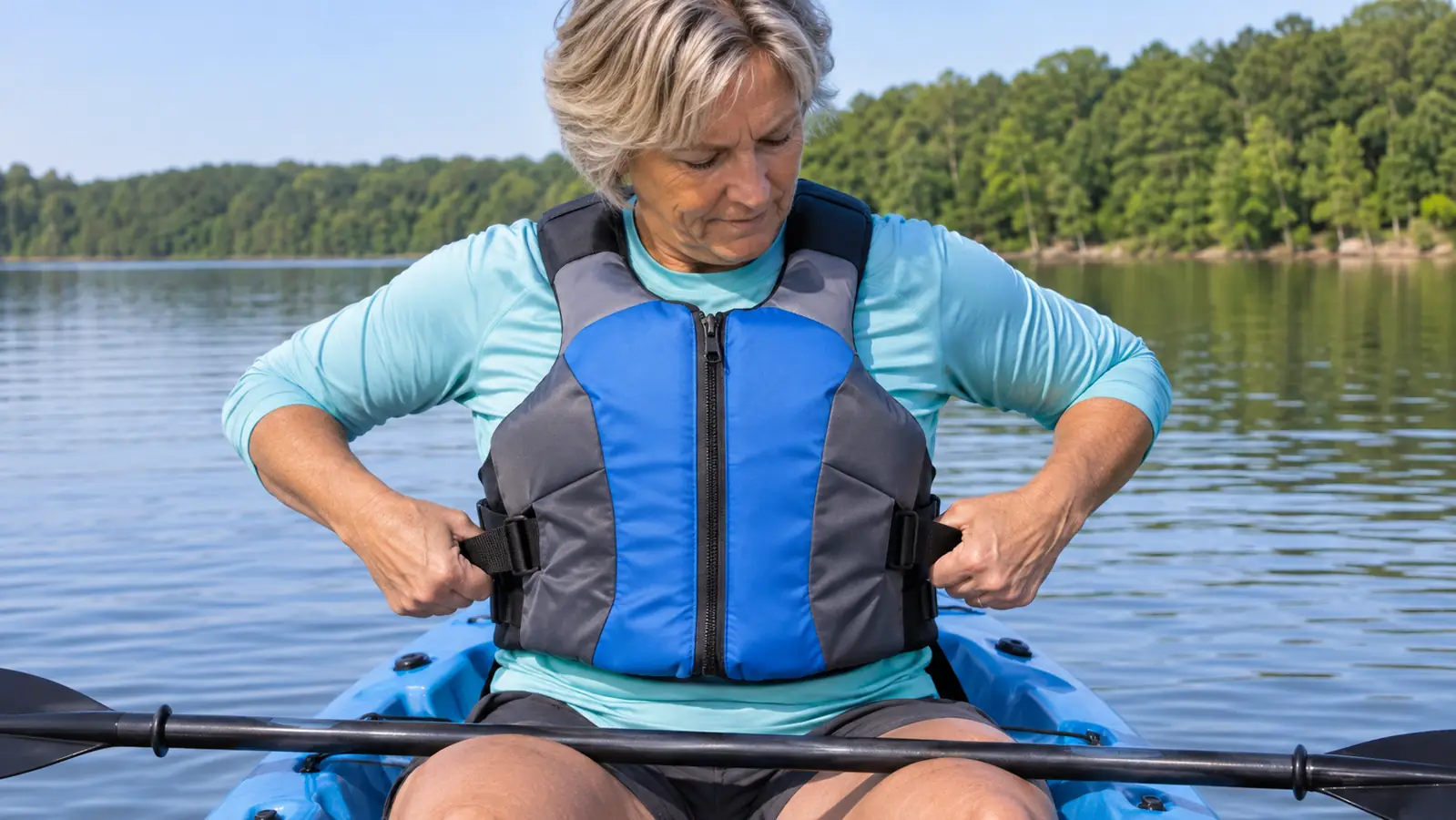
Step 2: Loosen Every Strap Before You Put It On
The vest closes with a zipper and a buckle. Undo both. Then back the side belts off several inches and let the shoulder straps out. Most people, and I was one of them for the first two trips, leave the vest set from last time and try to wriggle into it like a wet swimsuit, and then wonder why nothing sits right. You cannot adjust a vest that is already fighting you.
Put it on like a jacket, one arm at a time, and zip it before you touch a single strap. The zipper is what makes the two front panels behave as one piece. If you snug belts over an open zipper you will get a fit that feels fine standing still and comes apart the first time you lean forward to reach the water.
A word about the armholes. The MoveVent has large armhole openings, and that is listed as a comfort feature, but it also means the vest feels loose and floppy around the shoulders when it is unzipped and hanging open. Do not judge the fit at this stage. Judge it after step four, with everything closed and the belts set.
Step 3: Set the Shoulder Straps First
The shoulder straps set the height of the vest, and height is the whole game. The pads at the top are neoprene, the soft part that sits on your shoulders. I want the bulk of the vest over my ribs and belly, with the top edge low enough that I can turn my head and look over my shoulder for a ski boat without the vest pushing into my throat.
Tighten the shoulder straps a little at a time, both sides evenly, and raise your arms overhead between adjustments. If the vest slides up toward your ears when you reach up, the straps are too tight or the vest is too long for your torso. If it hangs loose and the top edge sags away from your chest, they are too loose. There is a middle setting and you will find it in about three tries.
I do this standing next to the truck, not sitting in the boat. Once I am seated with my knees up, everything shifts and the geometry changes. Adjusting straps from a seated position in a kayak is also a good way to drop a strap end in the water and spend the next ten minutes fishing for it while you drift.
The old jacket had my ribs for twenty minutes and then went under the bungee. With the Onyx fitted this way I have not taken it off on the water once.
Step 4: Snug the Side Belts Last, and Evenly
Now the side belts. These do the actual work of keeping the vest down against your body while you pull a paddle. I take up the left side until it is firm, then match the right side to it, then look down and compare. If one side is tighter than the other the vest rotates slightly, and one armhole rides higher than the other all day, which you feel in the shoulder by the second hour.
How firm is firm? I want the vest pressed against my body with no gap I can slide a hand into at the side, and I want to be able to take a full breath without feeling like I am wearing a belt. Mine end up snug enough that the front panels lie flat and the zipper is not pulling open at the bottom. If the zipper is straining, back the belts off a notch.
Then the lift test, which is the only check that really matters. Hook your thumbs under the shoulder area at the front and try to pull the vest straight up. It should not come up more than an inch or two and it should not reach your chin. If it slides, the side belts are not tight enough, no matter how tight the shoulder straps feel. That test told me more about my first two trips than anything else did.
Step 5: Run the Checks at the Ramp, Then Again Ten Minutes In
Carrying the kayak down to the water changes things. The walk at my launch is a couple hundred yards, part gravel and part grass, ending at a concrete ramp, and hauling a 50 pound boat on a cart works the vest loose a little. So I do the lift test again at the top of the ramp, check the closure, and push off. On the Onyx that is a zipper and a buckle, and I want both, not one or the other.
While you are standing there, find the whistle. It is built into the vest, and the one time you want it you will not be looking down and feeling around for it. Same with the reflective accents on the front and back. Those are for the boat that did not see you, not for you, so there is nothing to check beyond knowing they are not covered up by a jacket or a strap.
The last check happens on the water. Ten minutes of paddling settles the vest against you and the straps find their real position. I reach down and give each side belt a tug, and I make sure the mesh back panel is sitting against the seat backrest rather than bunched up under it. That is not strictly a fitting step, but it is the difference between a comfortable two hours and a backache I feel on the drive home.
What Else Helps
The vest is the piece that has to be right, but it does not work alone. The mesh back panel on the Onyx only does its job if there is a backrest for it to sit against. Before I had a real seat I was on the bare molded plastic with a folded garden kneeling pad, and the panel had nothing to rest on. With the padded seat strapped to the deck points, the panel lies flat and the two stop fighting each other.
The rest is small stuff, but it is the difference between getting out twice a month and finding excuses. The paddle comes apart into two sections in the truck bed and goes together in ten seconds. The dry bag with my phone, keys and a sandwich clips to a deck strap point so I am not digging around under my legs while the boat drifts. The cart means I am not winded before I reach the ramp, which matters more at 58 than it did at 40.
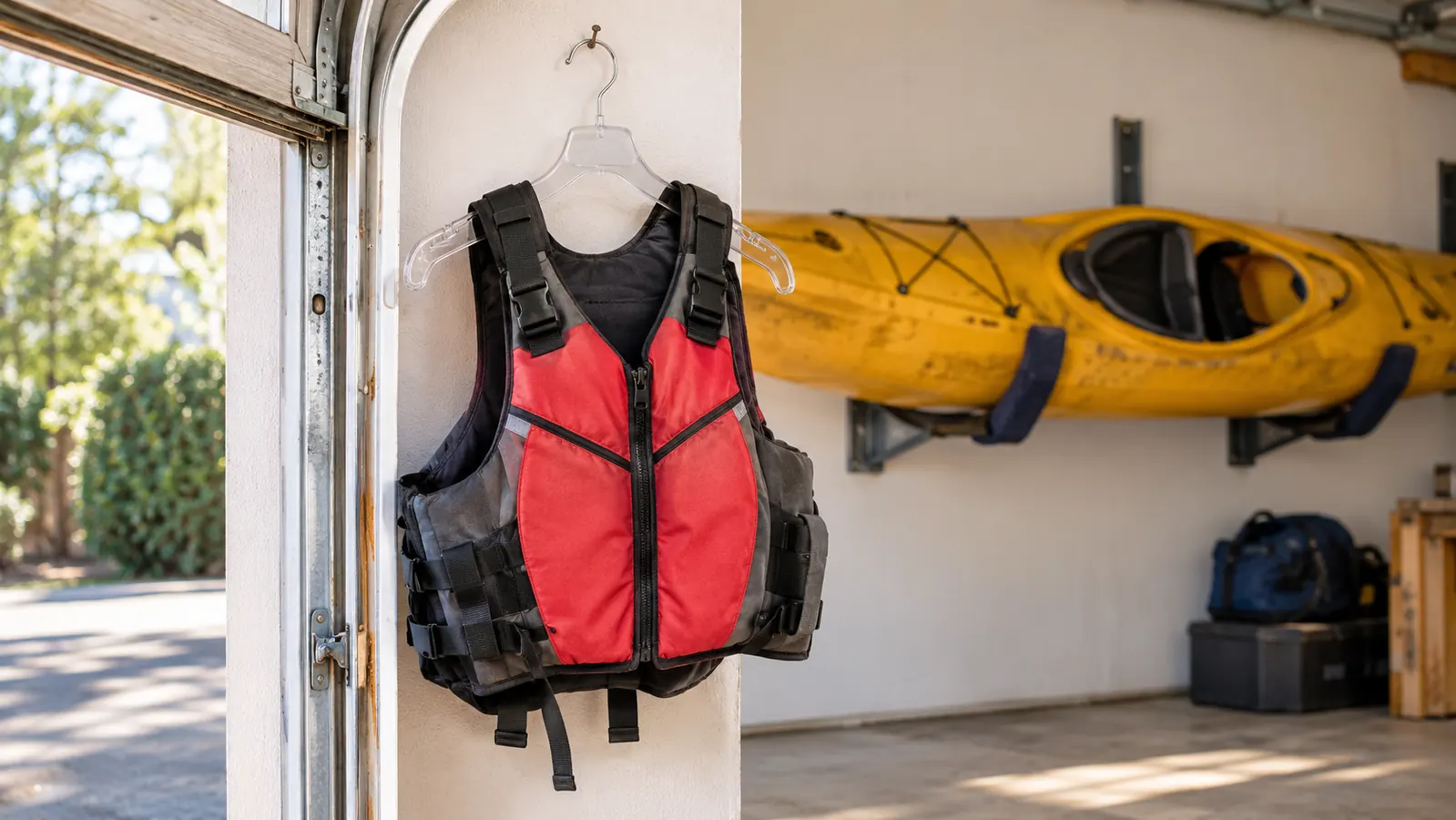
And the routine around it. Everything gets rinsed with the garden hose after a trip and dries in the garage, nothing stored wet. The vest hangs on a plastic hanger on a nail by the garage door instead of being folded into a bin, so the foam is not creased all week. I tell Ron where I am going and when I will be back before I pull out of the driveway. That is not a fitting step. It is just what I do.
Fit it once in the lot, then forget about it on the water
The Onyx MoveVent in Medium-Large, with adjustable side belts and shoulder straps, neoprene at the shoulders, a built-in whistle and a mesh back panel that accommodates most kayak seats. Worn on every trip since May 2025.
Amazon Check Today's Price on Amazon →