

I bought the Onyx MoveVent Dynamic in May 2025, and the first thing I will tell you is the thing I would want told to me. The sizing on this vest is a range, not a fit. My Medium-Large is rated for people from 90 pounds to 300 pounds. That is one shell covering about 210 pounds of difference, and it stays on your body because the side belts and shoulder straps do the work, not because the shell was cut to your shape. I am 5 foot 5 and medium build, and it works on me. But my first three trips involved a good deal of tugging at the ramp, and I would rather you knew that going in than found it out on the water.
I am 58 and retired from dispatching school buses in Radford, Virginia. I paddle a used 10 foot sit-on-top, about 50 pounds, bought from a neighbor in the spring of 2023, the year I retired. Claytor Lake and the calm stretch of the New River are where I go, April through October, about twice a month, daylight only. Before this vest I wore the blocky general purpose foam jacket that came with the kayak. It pushed up against the seat back, and on a hot day I would peel it off and tuck it under the deck bungee. That was a bad habit and I knew it was a bad habit. The Onyx is what ended it.
The Quick Verdict
The most comfortable vest I have worn in a kayak, and the reason I stopped shedding my jacket mid-paddle. But one Medium-Large shell across a 90 to 300 pound range takes a few trips to dial in, and it is still warm in August.
Amazon Check Today's Price →The Vest That Ended My Bad Habit of Taking It Off Mid-Paddle
Mesh back panel, adjustable side belts and shoulder straps, neoprene at the shoulders, built-in whistle, Coast Guard and Transport Canada approved. Medium-Large, 1.7 pounds.
Amazon Check Today's Price on Amazon →The Sizing Range Nobody Reads Carefully
Ninety to three hundred pounds is a wide net for one piece of foam and nylon. In practice it means the side belts have a lot of travel in them, and so do the shoulder straps, and the vest sits differently on a 110 pound woman than on a 290 pound man. I am closer to the bottom of that range than the top. To get it right on me, the side belts had to come in further than I expected and the shoulder straps had to come down. My first two trips I had it too loose, and it floated up around my ribs when I sat down in the kayak.
Here is how I check it now, standing in the gravel lot before I unload anything. I put it on, buckle it, zip it, and put both hands on the shoulders and try to lift the vest up over my head. If it comes up more than an inch or two, something is still loose and I tighten it. That is not a technique I got from a class. It is what I figured out after three trips of tugging at it in the boat. The neoprene at the shoulders matters here, because that is the part taking the pressure when you cinch down, and it does not cut in the way the old foam jacket did.
If you are a small person, you will be near one end of the adjustment on this thing, and if you are a large person you may be near the other end. Onyx sells this in Medium-Large as a single size and prints the range right on the listing, so nobody is hiding anything. I just do not think most people read a weight range and understand it means one shell for everybody inside it. I did not.

How I've Used It, Plainly
Eighteen months now, two trips a month on average, April through October, always daylight. The vest goes on in the parking lot before I unload the kayak, and it stays on until I am back at the truck. I do not take it off on the water. That is the entire reason I bought it. My husband Ron knows where I am going and when I will be back, my friend Sheila paddles with me in her own kayak, and neither of them has ever had to wonder whether I had my vest on.
The walk at my launch is a couple hundred yards, part gravel and part grass, ending at a concrete ramp. The vest goes on before that walk, not after. Partly that is habit and partly it is because I want to be buckled before I am anywhere near the water. It does not bother me on the walk. It weighs 1.7 pounds and sits close enough that I forget about it until I reach the ramp.
Packing order at home never changes. Seat and paddle in the truck bed beside the kayak, the folded cart behind the truck seat, the vest and the dry bag on the passenger seat. I am not going to pretend that is interesting. I mention it because the vest is the one piece of gear I handle twice on every trip, once at the truck and once at the ramp, and eighteen months of that has not made me dread it.
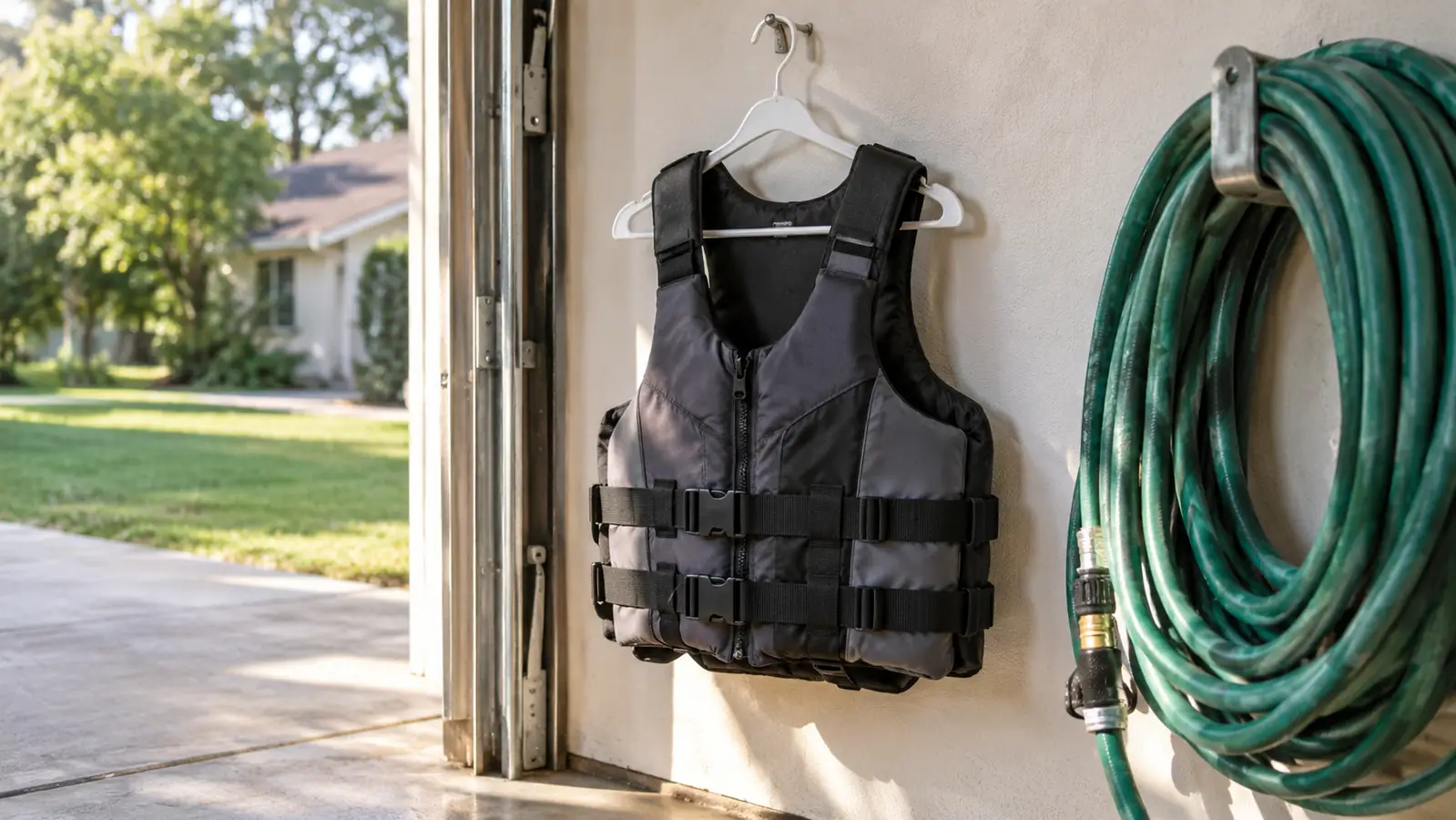
After every trip it gets rinsed with the garden hose and hung on a plastic hanger on a nail by the garage door. It has never gone away wet. That is all I do to it. No sprays, no treatments, no repairs. Eighteen months in, the nylon looks like nylon that has spent eighteen months in sun and lake water, which is to say it has faded some and it has not torn, and the buckles still snap the way they did in May of last year.
The Mesh Back Is the Reason It Stayed On
The back of this vest is a mesh panel, and the listing says it accommodates most canoe and kayak seats. That is the sentence that sold me and the sentence that turned out to be true. My seat has a padded backrest, and the old foam jacket was a solid slab against that backrest. Every time I leaned back, the two of them argued. The jacket pushed up, I pushed it down, and after an hour I was finished with it. With the mesh, the backrest presses into the opening and there is nothing to argue with.
The old jacket and my seat back fought each other all afternoon. The mesh panel ended the argument in one trip.
I want to be careful not to oversell that. The mesh does not make the vest cool. It makes it not hot in one specific place, which is the small of your back where you are pressed against a seat. My shoulders and chest still get warm, because they are wrapped in foam and nylon like any other vest. But the thing that used to make me take the old one off is gone, and it is gone for a reason I can point at instead of a feeling.
My seat sits on four deck strap points and the backrest is padded, which is the whole reason the vest had a job to do back there. If your seat is a bare molded pan with no backrest behind it, the mesh panel is not doing much for you. It is not a feature you get value from in the abstract. You get value from it because something is pushing on your back, and if nothing is pushing on your back, you are carrying a panel you will never notice.
The armholes are cut wide, and that is the other difference I noticed in the first ten minutes. My old jacket had me reaching around a wall of foam on every stroke. This one does not restrict my reach. I noticed it most on the side I paddle toward the wind, where I am working harder than usual.
Where It Falls Short, Honestly
August. That is the short answer on drawbacks. In July and August on Claytor Lake, with the sun on you and no wind, this vest is warm. Not unbearable, and I keep it on, but warm. I come off the water with a damp shirt under it, hang the vest on the nail, and it is dry by the next morning. If you expect to be cool in a foam vest in the middle of an August afternoon, no vest is going to give you that, this one included.
The straps take patience. There are side belts and shoulder straps and they interact, so tightening one changes how the other sits. My first three trips I was adjusting at the ramp, adjusting again fifty yards out, and adjusting one more time before I came in. It settled once I found the setting and I have not touched it since, but the settling took longer than I expected from a vest with this many reviews behind it.
There is nowhere on this vest that I put anything. That is not a fault exactly, since I knew it when I bought it, but it is worth saying out loud. My phone, keys, wallet, a small towel and a sandwich all go in a dry bag clipped to a deck strap point on the kayak. That works fine and it is what I did before. But if you are picturing a fishing vest with a dozen pockets, this is not that vest and it will not become that vest.
The rated range runs from 90 pounds up to 300, and the top of that is a large person. I cannot tell you how the vest sits on somebody that size, because I am not that size and I am not going to guess. What I can tell you is that the side belts carry enough slack that I believe the range is real, and that the same Medium-Large is what would go on Sheila if she ever needed to borrow it, and she is built differently from me.
The Small Things That Earned Their Keep
The whistle is built in on a short lanyard inside the front. I have never blown it on the water. I blew it in my garage to see whether it worked, and it does, and it is loud enough that Ron came out to ask what was wrong. That is the whole of my experience with the whistle and I am glad to keep it that way.
The reflective accents on the shoulders and back are SOLAS grade, and I can tell you they light up under a headlamp in my garage, which is the only test I have run. My paddling is daylight only, so reflectivity is not why I bought it. Sheila and I have stayed out later than we meant to once or twice, and it does not hurt to have something bright on you when the light goes flat.
The closure is a zipper plus two buckles, so there are two things to check instead of one, and after a season your hands do it without your looking. The neoprene at the shoulders is the piece I would miss most if I went back to the old jacket. The warranty is one year from the manufacturer. I have not needed it, and at eighteen months there is nothing on this vest that makes me think I will.
What I Liked
- Mesh back panel stops the seat backrest from pushing the vest up
- Adjustable side belts and shoulder straps hold a wide range of body sizes
- Wide armhole openings, so reaching for a stroke is not a fight
- Neoprene at the shoulders does not cut in when the straps are cinched down
- Built-in whistle and SOLAS grade reflective accents
- Coast Guard and Transport Canada approved
- 1.7 pounds, and it hangs dry in the garage overnight
Where It Falls Short
- One Medium-Large shell across a 90 to 300 pound range takes several trips to dial in
- Still warm in July and August, like any foam vest
- No place to carry a phone or keys, so you need a dry bag on the deck
- Side belts and shoulder straps interact, so adjusting takes patience at first
What I Compared It To, and Why
The only other vest I have owned is the blocky general purpose foam jacket that came with the kayak. It arrived with the boat, so it cost me nothing extra, and it did the basic job of being a life jacket. What it did not do was stay put against a seat back. That is the whole of my comparison, and it is why I am not going to tell you this vest beats every other vest on the market. I have not worn those.
I also have not been in the water with either of them. I have never capsized and I have never had to find out how a vest behaves when it is wet and holding me up. So I cannot tell you anything useful about flotation, and I would be careful of anyone who says they can after a season of calm lake paddling. What I can tell you is how the two vests behave sitting in a kayak for three hours, and that is the difference I am qualified to describe.
Who This Is For
This is for the paddler who has been wearing a general purpose life jacket in a kayak and has quietly started taking it off when it gets uncomfortable. That was me for two seasons. If your seat has a backrest and your old jacket fights it, the mesh panel solves a problem you may not have known had a solution. It is also for a household where one vest has to cover more than one person, since the range runs from 90 to 300 pounds and the belts do the adjusting.
Who Should Skip It
If you paddle in serious heat and you know in your heart you will not keep a foam vest on no matter what it looks like, this will not change your mind. The mesh helps your back and does nothing for your chest and shoulders. If you want pockets for tackle or a radio, this is the wrong vest. And if you sit at either end of that weight range and you want something cut for you specifically, a vest sold in several sizes will fit you better out of the box than a Medium-Large that has to be cinched down.
One more thing, plainly. If you have a back or a shoulder that gives you real trouble, that is a conversation for a doctor, not for a retired bus dispatcher on the internet. I have the ordinary stiffness that comes with being 58, and I can tell you what worked for me on a sit-on-top kayak on a calm lake. That is the limit of what I know.
Eighteen Months, Two Trips a Month, and It Has Never Come Off Mid-Paddle
If your old jacket rides up against your seat back, the mesh panel is the part worth looking at. Medium-Large, 1.7 pounds, Coast Guard and Transport Canada approved, with a built-in whistle.
Amazon Check Today's Price on Amazon →