

The box came in August 2025 and I had the seat clipped to my kayak before Ron finished his coffee. For the two summers before that I had been paddling on the bare molded seat of my used ten foot sit-on-top with a folded garden kneeling pad under me, and after about an hour my lower back would stiffen up and I would turn around and head for the ramp. So this Pactrade Marine padded seat with the detachable back bag was not an impulse buy. It was me admitting the kneeling pad had run out of ideas. Fifteen months and two trips a month later, I have a plain opinion of it: it fixed the thing I bought it to fix, and it has two small annoyances I still grumble about.
Here is the short version before I walk through the rest. The Pactrade Marine seat does what the listing says. It lifts me off the molded plastic, the backrest gives my lower back something to lean into on the back half of a trip, and the storage bag holds my sunscreen and a spare hat where I can reach them. What the listing does not say is that the front straps work themselves a little slack and want a tug after the first half hour, and that the padding holds water and needs a night in the garage before it goes back on the kayak. Neither one is a reason to send it back. Both are things I would rather have known going in.
The Quick Verdict
It fixes a stiff lower back on two hour lake trips and the back bag earns its keep. Budget one strap tug mid-trip and a full night to dry.
Amazon Check Today's Price →Fifteen months on the water and it is still the seat on my deck
Padded backrest and cushion, four adjustable webbing straps with brass clips, and a detachable storage bag that holds about 4.5 inches of items. It weighs 3.4 pounds and wants a sit-on-top deck with four strap points.
Amazon Check Today's Price on Amazon →What Actually Came in the Box
The Pactrade Marine seat arrived folded in on itself in a plain box with nothing I would call instructions. What was in there: the padded seat with its backrest, four adjustable webbing straps with brass clips, and the storage bag that attaches to the back. It weighs 3.4 pounds on my kitchen scale, close enough to the listed weight that I did not argue with it. That is not nothing on the walk down to the ramp, but I carry the seat, the paddle and the dry bag in one trip anyway, so it never registered as heavy.
The cushion measures about 15.74 inches across and 12.59 inches deep, and the backrest rises to 18.5 inches. I put a tape on it because I wanted to know whether it would clear the molded hump behind my seat, and it did with room left over. The materials listed are foam, neoprene and polyethylene. In plain terms that means a foam cushion under a neoprene cover, with a stiff panel inside the back so the backrest does not fold in half the moment you lean on it. The surface where you sit and where your back goes has a raised contour to it, not a flat slab, and it does not slide around under me the way the kneeling pad did.
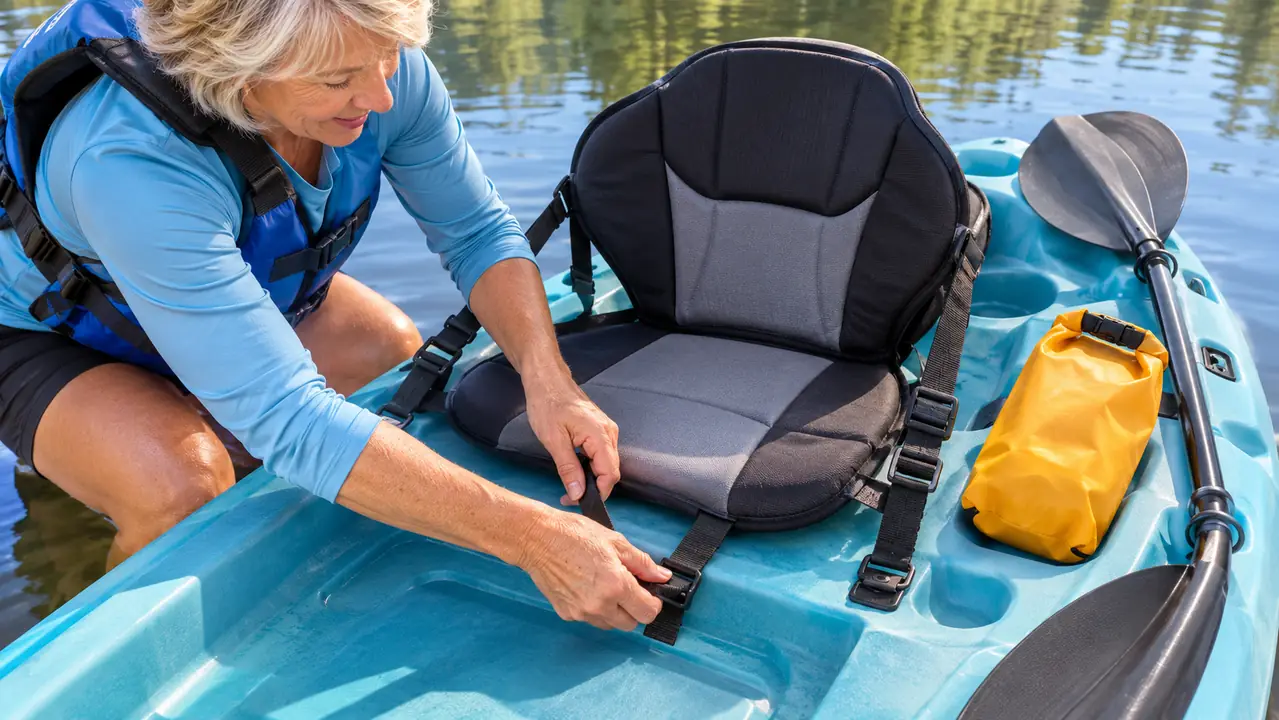
The four straps are the part that matters more than the padding, and I will get to why. They run two to the front and two to the rear, and the buckles sit on the back of the seat. My kayak has four strap points on the deck, which is what this seat expects. If yours does not, sort that out before you order rather than after.
How I've Used It, Trip by Trip
I paddle Claytor Lake and the calm stretch of the New River near Radford, April through October, about twice a month, always in daylight. My husband Ron does not paddle. He gets told where I am going and when I will be back, and that is the arrangement. My friend Sheila, who is sixty and has her own kayak, comes with me most trips. The launch I use has a gravel lot and a walk of a couple hundred yards down to a concrete ramp, part gravel and part grass, and since April I have rolled the kayak down on a cart instead of dragging it by the bow handle.
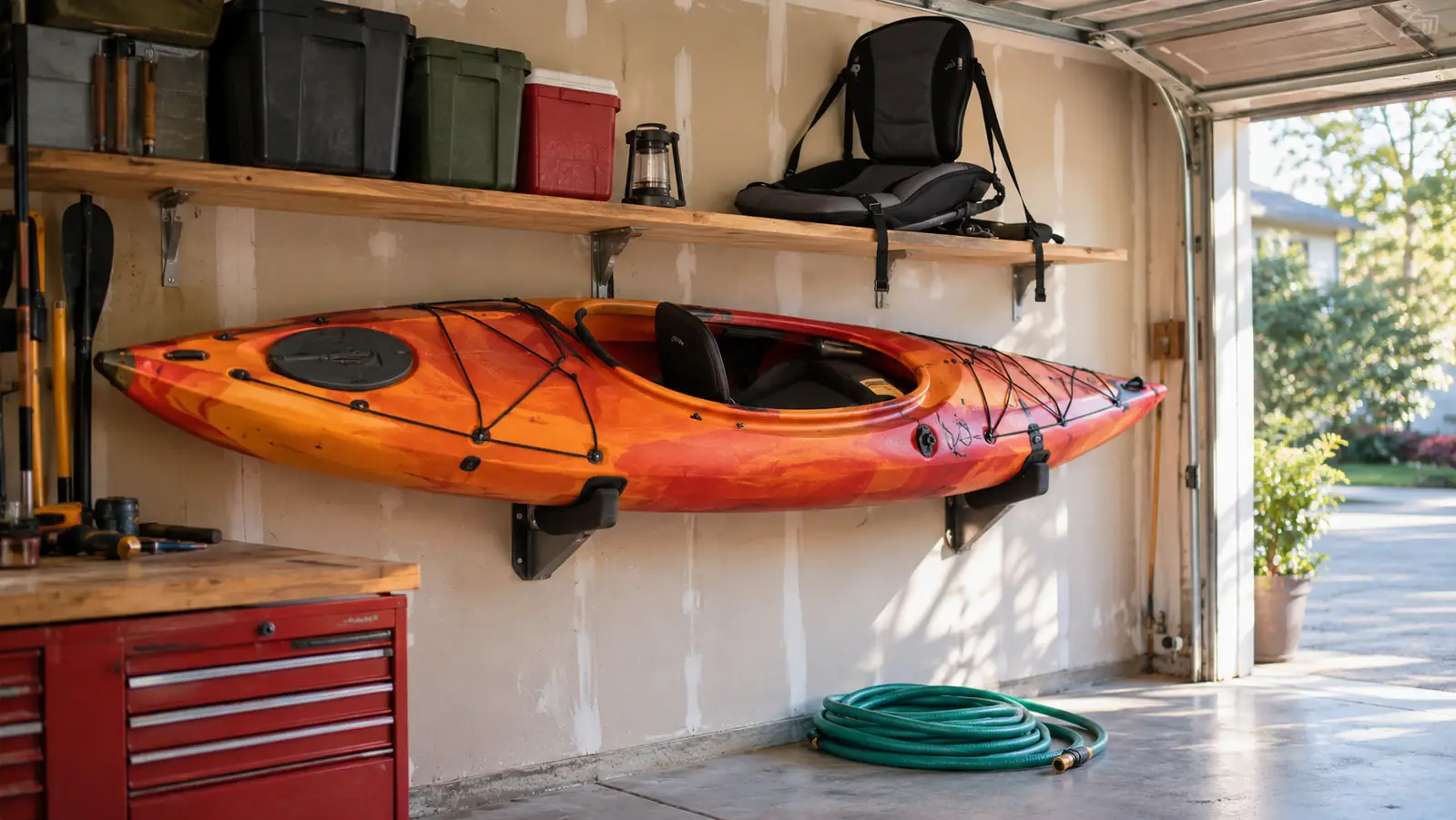
Every trip the routine is the same. Vest on in the parking lot before I unload anything. Seat clipped to the four deck points. Paddle stays in two sections until I get to the water. The Pactrade seat takes maybe a minute to clip in if the straps are already set from last time, longer if someone has been fiddling with them. It lives on the shelf above the workbench in the garage between trips, and after every trip it gets rinsed with the garden hose and left to dry, same as everything else I own.
On the water the difference from the bare seat is not dramatic, it is just steady. With the kneeling pad I was good for about an hour before my lower back started talking to me. With the backrest I am good for the two to two and a half hours I actually paddle, and I get out because I am done, not because my back is done. It does sit me up a little higher than the molded seat did, which I noticed for the first ten minutes and have not thought about since. I am five foot five and medium build with the ordinary stiffness that comes with being fifty eight. I am not an instructor and I am not telling anybody what to do about their back. I am telling you what changed for me.
The trip that sold me on it was a still, hot morning in July on the lake with no wind to speak of. I paddled up the shoreline and back without stopping, two hours and change. On the kneeling pad I would have turned around at the halfway point and told myself I was being sensible. That is not a scientific test, it is just what happened.
With the kneeling pad I was good for about an hour. With this backrest I get out of the kayak because I am finished, not because my back is finished.
The Strap Habit Nobody Warns You About
Here is the one thing I would put in bold on the listing if it were mine. The straps loosen. Not all at once and not dramatically, but somewhere around the half hour mark the front two have gone a little slack and the seat has shifted back maybe an inch. You feel it more than you see it. The first few trips I stopped and re-tugged them and was annoyed about it. Now I reach down, give each front strap a pull, and keep going. Five seconds. It is not a defect, it is what webbing under load does, but nobody mentions it and I would rather you heard it from me than figured it out on the water.
The fix, such as it is, is to set the straps properly the first time and check them before you push off, not after. I set mine snug on the deck at home, not so tight the seat is squashed, and that cut the slack down to where one mid-trip tug handles it. I have not had a strap come undone and I have not had a brass clip let go. It is a loosen, not a failure.
The other half of the strap story is fit. My kayak has four deck strap points and this Pactrade Marine seat uses all four. If yours has only two, or has them in the wrong place, you will be improvising, and an improvised seat that shifts under you is worse than no seat at all. That is not a knock on the seat. It is just how it attaches.
The Back Bag Is a Bag, Not a Backpack
The storage bag attaches to the back of the seat and holds, by the listing, about 4.5 inches worth of items. Mine carries a tube of sunscreen, a spare hat, and my keys on the days I forget to put them in the dry bag. That is about the honest limit of it. It is not a backpack, whatever the product title says, and it will not hold a change of clothes or a lunch. The detachable part is genuinely useful, because I can unclip it and carry the sunscreen and hat down to the water in one go instead of making two trips back up the ramp.
Two cautions. The bag sits behind your back, so anything you put in it needs to be flattish or you will feel it against your spine. And it is not waterproof. My phone goes in the dry bag, clipped to a deck point, not in the back bag, and that arrangement has not changed since a June morning in 2024 when water came over the side and my phone spent two days refusing to turn on before it came back to me. That was before I owned a dry bag. I have not repeated it.
The Padding Stays Damp, and That Is On You
Foam under neoprene holds water. That is not a flaw in this Pactrade Marine seat, it is what the material is. After a couple of hours on the water, and especially on a humid August morning, the cushion is damp through and it will still be damp at supper. If you fold it up, put it in the truck bed, and set it on a shelf that night, you will have a seat that smells like a lake by September.
What I do is rinse it with the hose, stand it up on the shelf above the workbench with the backrest open, and leave it overnight. By morning it is dry. That is the entire maintenance routine. No sprays, no treatments, nothing else. Fifteen months of that and the cover has not cracked or gone chalky and the foam has not gone flat. It is 3.4 pounds now, same as it was in the box.
Where It Beats the Foam Pad, and Where It Does Not
The folded garden kneeling pad I used before had exactly one virtue: it was already in the garage. It raised me maybe an inch and a half, it slid forward every twenty minutes, and it did nothing for my lower back because there was nothing behind me to lean on. That last part is the whole ballgame. The padding on this seat is not dramatically softer than a kneeling pad. The backrest is the difference, and the four straps are what keep the backrest where you put it.
Where the foam pad wins is packing. It folds flat into nothing and it never needs drying. If I were paddling twenty minutes out and twenty minutes back on a pond, I would not bother with a seat at all, and I would not tell anyone else to either. The Pactrade Marine seat earns its place at the one hour mark, not before.
Two Things I Would Change
First, I would put a note in the box about the front straps going slack, because I spent two trips thinking I had rigged it wrong and one of those trips I cut short over nothing. Second, I wish the back bag were a little bigger, because 4.5 inches of space fills up faster than you would think once sunscreen and a hat are in there. Neither is worth a star off. They are the kind of thing you write in a review after fifteen months and not after fifteen minutes.
And that is the honest summary. Nothing here is broken. The seat does the job I bought it for, still, fifteen months in, with two small irritations I have made peace with. If you want a seat that requires no attention at all and dries in ten minutes, that is a different kind of seat and you will pay for it. I was not going to, and I have not regretted it.
What I Liked
- The backrest is what makes a two hour trip possible instead of a one hour trip
- Four adjustable webbing straps with brass clips hold it steady on a deck with four strap points
- The detachable back bag keeps sunscreen and a spare hat where I can reach them
- The contoured non-slip surface keeps me from sliding forward the way the kneeling pad did
- Fifteen months of rinsing and air drying and the foam has not flattened
Where It Falls Short
- The front straps work slightly slack after about half an hour and want a tug
- The padding holds water and needs a full night to dry
- The back bag holds about 4.5 inches of flat items and is not waterproof
- It only works properly on a kayak that already has four deck strap points
Who This Is For
Recreational paddlers on sit-on-top kayaks with four deck strap points, doing trips of an hour and a half to three hours on flat water, who find the molded seat has them stiffening up before they are ready to quit. If you are in your forties or past it and your lower back starts complaining an hour in, the Pactrade Marine seat is the cheapest change I know of that gets you to two hours. The back bag is a nice small bonus for the sort of person who wants sunscreen within reach rather than behind them in a hatch. It suits a lake or a calm river. It is not a whitewater seat and I would not know how to judge one.
Who Should Skip It
Skip it if your kayak does not have four deck strap points, because the whole thing depends on being strapped down at four corners. Skip it if you are after a framed stadium seat with arms and a tall back, because this is a padded cushion with a backrest, not a chair. And skip it if you know yourself well enough to know you will not rinse it and air it out, because a damp foam seat left in a closed garage is a smell you will not get back out.
And skip it, or at least talk to a doctor first, if the problem is more than ordinary stiffness. I have a stiff lower back that comes with being fifty eight. I never saw anyone about it, I do not have a diagnosis, and I am not going to pretend a foam cushion treats anything. If your back or shoulders are a real medical matter, that is a different conversation with a different person.
If one hour is all your back will give you, this is the change I made
Padded backrest and cushion, four adjustable webbing straps with brass clips, detachable storage bag, 3.4 pounds. Set the straps at home, check them before you push off, and hang it open to dry when you get back.
Amazon Check Today's Price on Amazon →