
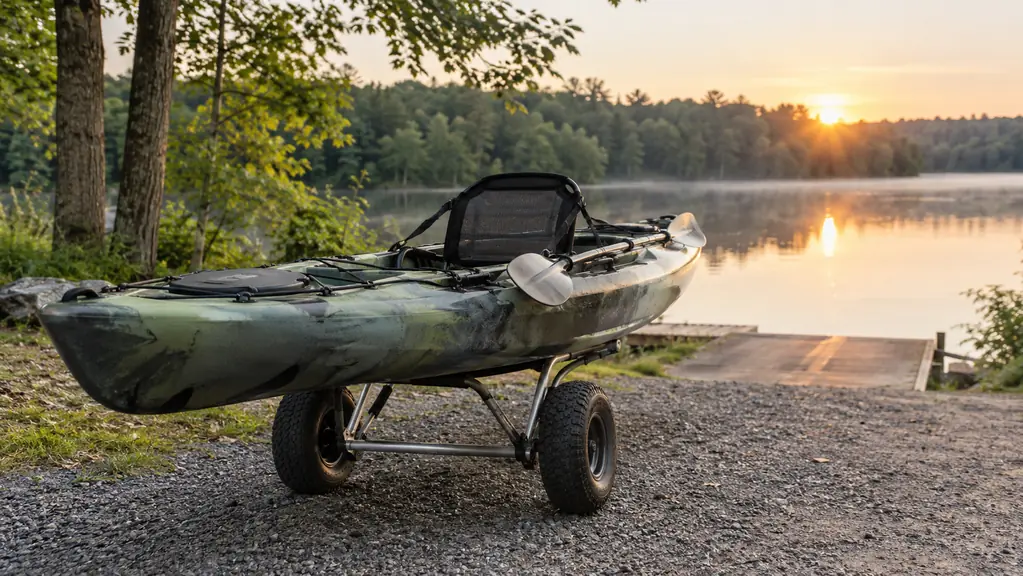
I bought the Bonnlo kayak cart in April 2026 with my own money, and I will start with the part a product page never tells you: my first two trips with it were not good. I had the kayak sitting too far back on the frame and it kept wanting to lean over on the grass. That was my mistake, not the cart's. Once I centered the kayak, the walk from the gravel lot down to the concrete ramp stopped being the worst ten minutes of my morning.
I am 58, retired from dispatching buses for the county, and I paddle a used 10 foot sit on top that weighs about 50 pounds. I go out about twice a month from April through October on Claytor Lake and the calm stretch of the New River. Before the cart I dragged that kayak by the bow handle or waited for my friend Sheila to take the other end. I am not a gear person and I am not an instructor. What follows is what seven months actually taught me, including the parts I do not love.
The Quick Verdict
It does the one job I bought it for: rolling a 50 pound kayak a couple hundred yards by myself. It rattles your teeth on gravel and it will tip if you load it crooked.
Amazon Check Today's Price →The cart that ended the two person carry
Solid airless tires, folding aluminum frame, rated to 200 pounds. It rides folded behind the truck seat and comes out every trip from April to October.
Amazon Check Today's Price on Amazon →What Nobody Tells You Before You Buy a Kayak Cart
Every cart in this range is described the same way. Aluminum frame, airless tires, folds up, holds a lot of weight. What the descriptions leave out is that a kayak cart is not really a transport device. It is a balance device. The wheels do the rolling. Your hand does the balancing, and if you do not want to spend the walk fighting it, the kayak has to sit centered with its weight over the axle.
That sounds obvious written down. It was not obvious to me at the ramp with a truck bed full of gear and a line of people waiting. The second thing nobody tells you is that the surface you walk on matters more than the cart you buy. My launch is a couple hundred yards, part gravel and part grass, ending at a concrete ramp. Gravel and grass are two different jobs, and no cart is perfect at both.
How I've Used It
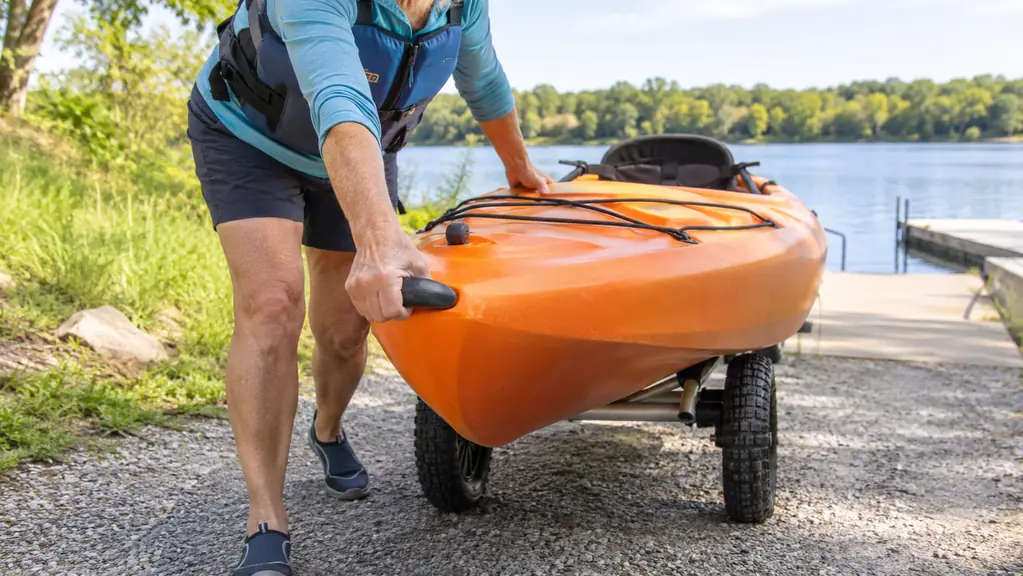
My routine has not changed since April. I pull into the gravel lot, put my vest on before I unload anything, then lift the kayak out of the Tacoma bed, where it rides with a red flag on the end. The cart lives folded behind the truck seat. I open it, set the kayak on the frame, and strap it down. Then I take the bow and walk it down to the ramp with the whole thing rolling in front of me.
There is one detail from that first April trip I still think about. I had loaded the kayak with the stern hanging off the back of the frame, because that is where the strap point I liked happened to line up. The cart rolled fine on the concrete. Then I hit the grass and the whole thing rotated on me like a shopping cart with a bad wheel, and I caught it with my forearm before it went over. I did not know then what I know now, which is that a 50 pound kayak has to sit with its weight over the wheels. Once I moved it forward about a hand's width, it stopped doing that. I have loaded it the same way every trip since, and I can tell in one look whether it is right, the same way you can tell a truck is overloaded by how it sits.
The strap I use is a cam strap I already had in the garage. The cart ships with two ratchet straps and they are perfectly fine, but I got used to mine and I am not going to change a habit that works. Either way, strap it. Not because the frame is slippery, but because the first time the kayak shifts an inch you will feel it in your wrist, and you will not enjoy the rest of the walk.
One trip stands out because it was the first time the cart made a visible difference to somebody else. Sheila met me at the lot in June and I had the kayak on the cart and rolling before she had her vest zipped. She looked at it and said, well, that is one way to do it, and went back to taking an end of hers. I am not going to pretend she was converted. But I was down at the ramp alone, with my own boat, and that had not happened before April.
Coming back up is the part I did not think about before I bought it. After two hours on the water my lower back is stiff and my shoulders are tired, and hauling a kayak uphill by the handle was always the moment I regretted the whole outing. Now I roll it. That is the honest summary of what changed. Not the launch. The walk back.
What You Actually Get
The Bonnlo cart is a foldable aluminum frame, about 5 pounds, rated to 200 pounds. The tubing is larger diameter than some of the cheap carts, 20 by 2 millimeter anodized aluminum according to the listing, and I can tell you it does not flex under my kayak. The tires are solid polyurethane, 10 inches in diameter and 3 inches wide, which is why the listing calls them airless. There is no tube to patch and no valve to check, and for me that is the entire point. I have had a bicycle tire go flat on a gravel road and I did not want to repeat that at a boat ramp.
Two ratchet straps come in the box, and I want to be fair to them because I do not use them. They are the standard ratchet type with a hook on each end, long enough to go over a sit on top deck without any trouble. I kept the cam strap I had been using since I first started strapping the kayak into the truck bed, because I can tighten it with one hand and I do not have to think about it. If you are starting from nothing, the included straps will do the job and you will not need to buy anything else. That matters to me more than it used to. I have bought enough gear that arrived needing one more piece before it worked.
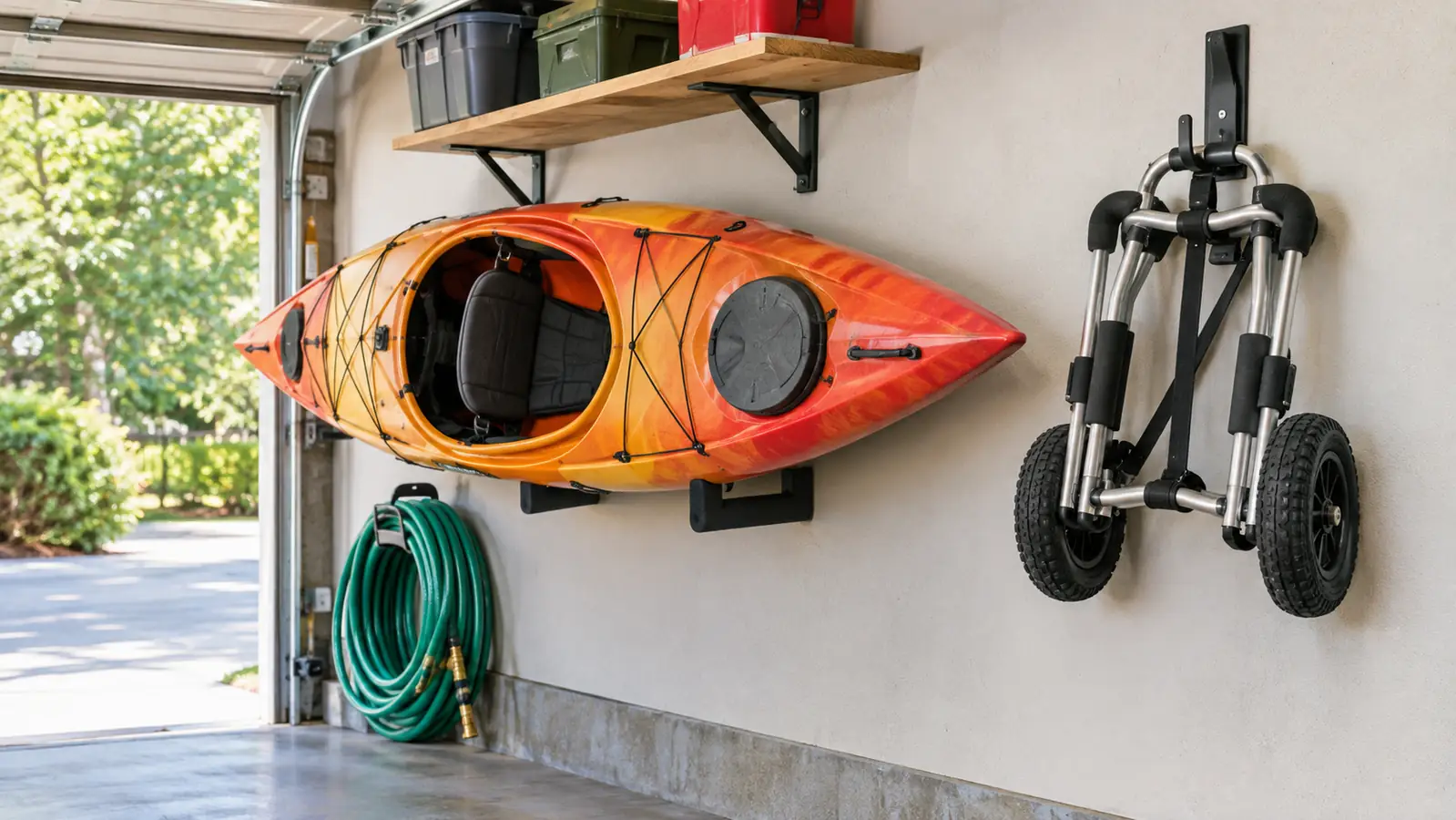
Storage is the part I did not think about and now appreciate. The cart hangs folded on a hook beside the kayak in the garage, next to the two padded wall brackets. I rinse it with the garden hose after every trip, same as the paddle and the vest and everything else, and let it dry in the garage. Seven months of that and the frame has not spotted or stiffened. The folding joint still moves the way it did in April. I do not wax it or spray it or do anything to it, because I would forget, and so far forgetting has not cost me anything.
It folds down flat enough to slide behind the seat of a pickup, which is where mine lives from April to October. At 5 pounds it is not light enough to forget you are carrying it, but it is light enough to carry in one hand with a paddle in the other. The 200 pound rating is a great deal more than my 50 pound kayak needs, and I would rather have margin than a number that matches exactly.
Seven months, about twice a month, and I have not once needed Sheila to take the other end.
The Gravel Is the Whole Story
Before the cart I did the obvious thing, which was drag the kayak by its bow handle. On grass that works, sort of, if you do not mind the boat plowing a groove. On gravel it does not work at all. The hull catches on the loose stone and the whole boat skips, and you end up dragging it sideways without meaning to. By the time I got to the water I was out of breath and cross, and I had not even launched yet. Sheila and I tried taking an end each, and that was better, but it meant our trips had to line up, and hers do not always line up with mine.
Here is the drawback I would want a stranger to tell me. Solid tires do not absorb anything. On the concrete ramp they are smooth and quiet. On the packed gravel of the parking lot they send every stone straight up through the frame into the kayak, and the kayak rattles. Nothing is getting damaged. It is just loud and jolting, and if your back complains, you will feel it in your hands and arms more than you expect.
The worst of it was a Saturday in July, when I got to the lot late and had to park at the far end, which added maybe forty more yards of gravel. By the time I reached the ramp my hands were buzzing and I had to set the kayak down and shake them out before I could lift it into the water. Nothing was wrong with the cart. Nothing was wrong with the kayak. It is just what a solid wheel does on loose stone, and forty extra yards of it is forty extra yards of rattling. On my usual spot, close to the ramp, I do not notice it nearly as much, which tells you the surface matters as much as the distance.
Grass is the opposite problem. The wheels are wide enough at 3 inches that they do not sink straight away on our lake lawn, but wet grass in April is slow going and the cart wants to follow the slope rather than the direction you are pushing. Air tires would handle both surfaces better. Air tires also go flat, and I have no interest in owning a pump for a kayak cart. That is the trade, and I made it with my eyes open.
The other thing worth saying plainly: the Bonnlo cart does not climb. There is a slight rise between the lot and the ramp at my launch, maybe a foot over the whole length of the walk, and on that rise I am pulling rather than pushing. It works. It is not effortless. Anyone picturing a cart that glides is picturing a different product than this one.
Where It Beat My Expectations
Loading and unloading is faster than I expected. I had built up a picture of fiddling with pieces in the parking lot in the dark, and it is not that. The frame opens, the kayak goes on, the strap goes over. I am back in the truck in under two minutes, and I am not a quick person in the morning.
The second surprise is how steady it is once the kayak is centered. I walk beside it with one hand on the bow and it tracks straight. It does not wander. When I had the kayak too far back it wanted to tip, and that tipped me off that the balance point is not a suggestion. Centered, it is steady enough that I have walked it one handed while carrying my dry bag in the other, and the walk stopped feeling like a job I had to brace for.
The third is how much less I dread the trip home. I used to plan around the carry back. If the wind came up on the lake or I stayed out longer than I meant to, that walk uphill with a dead kayak was a punishment, and I would cut my morning short to avoid being tired for it. Now the walk back is the same walk as the walk down, just in the other direction, and I have stopped scheduling my paddling around my own fatigue. That is not a line on the listing. It is the actual thing I got for my money.
And on the concrete ramp the cart is quiet and tracks dead straight. That last stretch is the easiest part of the whole walk now, instead of the part where I worry about dropping the boat. I have rolled it down that ramp alone, in the wet, in April, without a second thought, and I would not have tried that dragging it by the handle.
The Drawbacks, Plainly
Three things I would change. First, the ride on gravel, which I have already covered, and which no solid tire is going to fix. Second, you grip the bare frame tubing to pull it, and on a long walk that is a firmer grip than I want at 58 with the ordinary stiffness in my hands that comes with the age. Third, folded, it does not stay put behind the truck seat unless I wedge it against something, so it slides around on turns.
And one more, which is really about me and not the cart. The Bonnlo cart solved the walk. It did not solve the lift. I still have to get a 50 pound kayak off the ground and onto the frame, and then off the frame and into the water. My back notices that twice a trip. The cart removed the dragging, not the lifting, and anyone shopping for one should know the difference before they order it.
What I Liked
- Rolls a 50 pound kayak a couple hundred yards without a second person
- Solid airless tires, so no tube to patch and no pump to carry
- Folds down and fits behind a pickup seat
- 200 pound rating leaves plenty of margin over a recreational kayak
- Aluminum frame does not flex under a loaded sit on top
- Two ratchet straps included, so there is nothing extra to buy
Where It Falls Short
- Solid tires send every stone on gravel straight up through the frame
- Wants to tip if the kayak is not centered over the axle
- Slow going on wet grass, and it follows the slope
- Does not help you lift the kayak on or off the frame
- Folded, it slides around behind the truck seat
- Pulling on bare frame tubing gets tiring on the hands
Who This Is For
This is for the paddler who launches alone and has a real walk between the truck and the water. That is the whole case. If your launch is ten feet from your parking spot, you do not need this and you should keep your money. If you have a friend who always takes the other end of your kayak, you do not need it either, though I would say you are one cancelled trip away from needing it. If you are like me, one kayak around 50 pounds, a gravel lot, a couple hundred yards of walk, this cart turns the worst ten minutes of the trip into something not worth mentioning.
It also suits anyone who does not want one more thing to check before leaving the house. I have enough of those. The fact that these wheels cannot go flat is worth more to me than a smoother ride over gravel would be, and that is the honest way to decide between them.
Who Should Skip It
Skip it if you launch from a dock with a parking spot beside it, or if your kayak is much lighter than mine and you have never had trouble with it. Skip it if lifting is your real problem, because this cart does not lift anything, it rolls. That is a question for your doctor, not for a review. And skip it if a jolting ride over gravel would bother you more than asking someone for a hand would. I made that trade and I am content with it. That does not mean you will be.
Seven months in, it still goes in the truck every trip
Folding aluminum frame, solid 10 inch airless tires, rated to 200 pounds. If your launch is a walk rather than a step, this is the piece of gear that changes the morning.
Amazon Check Today's Price on Amazon →