
The hardest part of kayaking was never the paddling. It is the couple hundred yards between the gravel lot and the concrete ramp at Claytor Lake. My boat is a used 10 foot sit-on-top, about 50 pounds, with four strap points on the deck where the seat clips on. Fifty pounds does not sound like much until you have carried it that far in the sun with a paddle tucked under your other arm. I am 58 years old. I have the ordinary stiff back and shoulders that come with the number, and I am not looking for a workout before I get on the water.
For three seasons I did it the hard way. I dragged the boat by the bow handle and stopped twice to rest, or I waited on my friend Sheila to come take the other end, which meant my whole morning ran on her schedule instead of mine. In April of 2026 I bought a Bonnlo kayak cart, the foldable aluminum one with the solid tires and the two ratchet straps in the box. It weighs about 5 pounds and it is rated to 200. I have not dragged the boat once since. What follows is not really a review. It is the five step routine I worked out in that parking lot, the one I now run by myself in about four minutes.
Four Minutes in the Lot Beats Two Rest Stops on the Walk
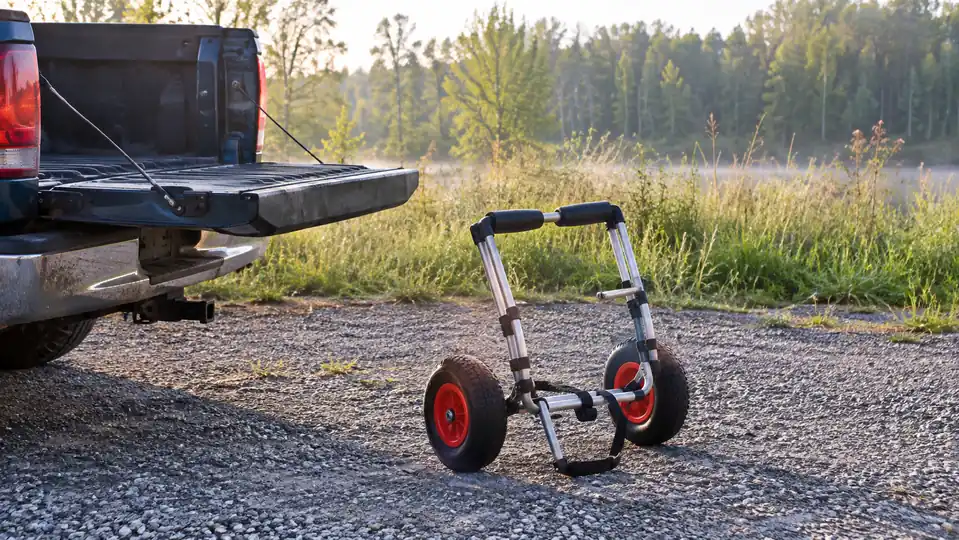
The Bonnlo cart folds flat, weighs about 5 pounds and carries up to 200. The tires are solid PU, 10 inches by 3, so there is no air to check and nothing to go flat. It rides behind the truck seat between trips.
Amazon Check Today's Price on Amazon →Here is the order I do things in. The order matters more than it sounds like it should, mostly because doing step two before step one is how you end up with a boat sitting on the gravel and nowhere good to put it.
Step 1: Open the cart and park it where the boat is going to land
I put the vest on first, in the lot, before anything else comes out of the truck. That is a habit I picked up and kept. Then I lower the tailgate and set the folded cart on the gravel about three feet back from the bumper, so there is room to slide the boat out and set it down without stepping over anything. Getting the cart in the right place first sounds fussy. It saves a step later when the boat is already off the truck and you have nowhere to put it.
The cart folds out into its working shape and the wheels sit flat on the ground. There is nothing to inflate and nothing to check before you load it. That was the whole reason I picked this one over anything with air tires. The tires are solid PU, 10 inches across and 3 inches wide. Solid means simple, and simple is what I want at seven in the morning.
Pick your ground before you pick your spot in line. I park on the high side of the lot when there is a choice, closer to the top of the slope than the bottom. Pushing a loaded boat uphill over loose gravel is a different job than letting it roll downhill, and you feel the difference in your shoulders before you feel it anywhere else.
One more thing about the lot. Gravel is the worst surface this cart sees and it is the one I have the most of. The walk at my launch starts in gravel, turns to grass about halfway, and ends on concrete. Three surfaces, one cart, same five steps every time.
Step 2: Slide the boat out and find the balance point
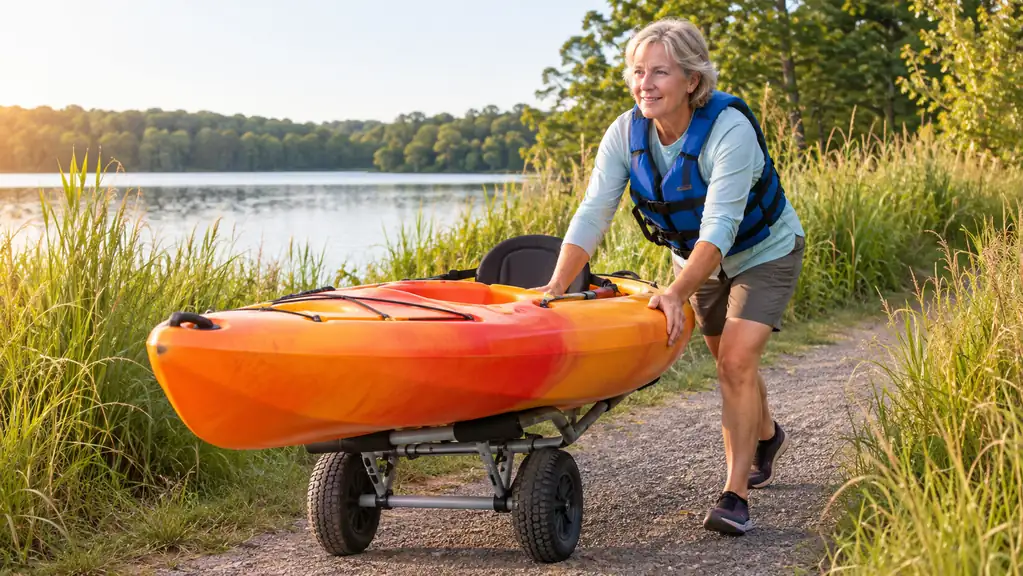
With the tailgate down I slide the kayak back until the stern clears the bed, take the stern in both hands, and set it down easy on the cart. The cart's limit is 200 pounds and my boat is 50, so weight was never the question. Balance is the question, every single time.
The boat goes on the cart a little ahead of the middle. Too far back and the bow drops, and you end up lifting dead weight with one hand while the other one holds a strap. Too far forward and the stern drags on the gravel. Somewhere around a third of the way back from the bow is where mine sits level, and I found that by setting it down, lifting the bow an inch, and sliding the hull until it floated even in my hands.
Then I look at it from behind the truck before I strap anything. If the hull is not centered side to side, the load leans, and a leaning load wants to tip. That is the one honest complaint I have about this cart, and it is really a complaint about me. Centered, it rolls straight the whole walk. Off by an inch, I fight it the whole way.
Step 3: Two straps, one over the hull and one forward of it
The cart comes with two ratchet straps. I keep them in the truck bed with the red flag I tie on the end of the boat, and the first strap goes over the top of the hull and clicks down snug. Not tight enough to press into anything. Snug enough that the boat and the cart travel as one piece instead of two pieces that happen to be sitting near each other.
The second strap goes forward of the first, over the hull again and hooked low on the frame. Between the two of them the boat cannot slide forward, cannot slide back, and cannot lift off when I cross a rut near the top of the walk. I also keep one old cam strap of my own in the truck. Some days I add it at the bow, some days I do not. Two good straps and a spare is about right for a gravel lot with a slope in it.
Twenty yards into the walk I stop and put a hand flat on the hull. If anything has shifted, it has shifted by then, and it is easier to fix standing still than halfway down a slope with the boat trying to get ahead of me. It takes five seconds. Most trips I just put my hand there and keep walking.
The cart is rated for 200 pounds and my boat is 50. Weight was never the problem. Balance was, and centering the hull is what fixed it.
Step 4: Push from behind and look at the water, not the wheels
I stand behind the stern with both hands flat on the hull and push. Not pull. Pulling means walking backwards over ground you cannot see, and I have done that with a loaded wheelbarrow and I do not recommend it either. Push, walk forward, watch where you are going.
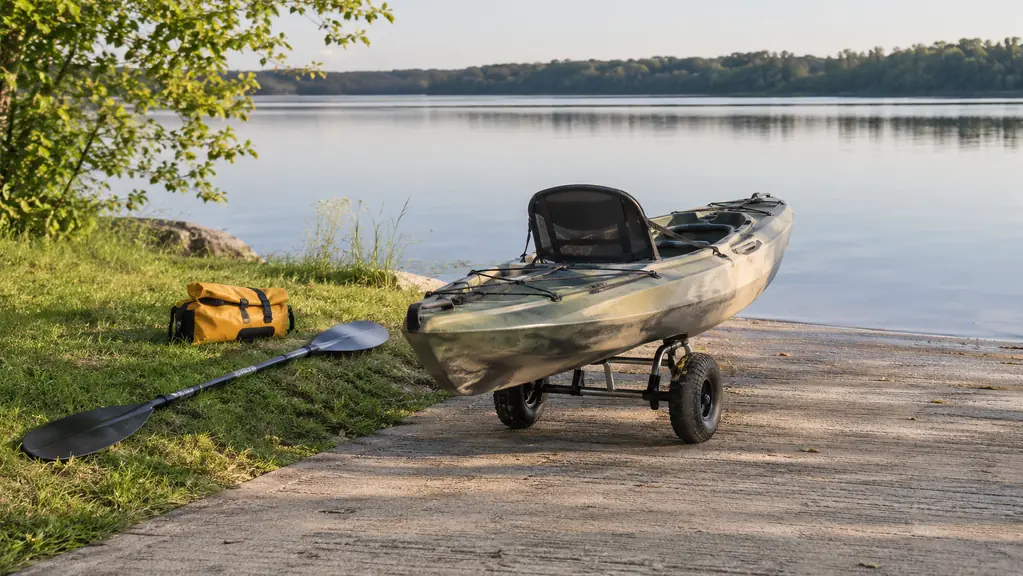
On the gravel the cart jolts. The tires are solid, so every rock comes up through the frame into the boat and into my hands. It is not painful, it is just busy. On the grass stretch it smooths right out and I can hear it stop rattling. When I reach the concrete ramp I slow down and keep both hands on, because a boat on wheels on a wet slope will get away from you if you let it.
The whole walk is a couple hundred yards and it takes about as long as walking it empty. That is the part I still appreciate. Two trips a month, April through October, and I have not once had to set the boat down in the middle of the walk and rest. For a 50 pound boat and a 58 year old back, that is the entire point.
Step 5: Unstrap at the water, then walk the cart back up
I do not take the straps off in the lot. I roll the whole thing down the ramp to the flat at the water's edge and unstrap there. Then I take the bow, lift, and slide the boat off the cart into the shallow water at the bottom of the ramp. Unstrap in the lot and you are back to carrying, which is the exact thing I was trying to stop doing.
The cart folds flat and weighs about 5 pounds, so I carry it back up to the truck in one hand, slide it behind the seat, and walk back down to the boat. That is the only part of the routine that goes against me, and it is one hand and one trip.
Coming in, I run the whole thing in reverse. Boat out of the water, set on the cart at the bottom of the ramp, strapped down, rolled up, loaded in the bed with the red flag on the end. Loading alone is the same trick backwards, stern up on the tailgate first, then lift the bow and slide. After that everything gets rinsed with the garden hose at home and left to dry in the garage. The cart hangs on a hook beside the boat.
What Else Helps
Take the seat and the paddle out of the boat before you set it on the cart. My seat is a padded one with a bag on the back, about 3.4 pounds, and the paddle is another 2.5. That is close to six pounds you do not need to balance on a gravel slope. I pull both out first and lay them in the grass where I can see them.
Wear the vest before you unload, not after you launch. Mine has a mesh back panel and side belts, and I put it on in the parking lot. If it is already on, I am not juggling it along with the paddle and the dry bag, and I am not the person who gets to the water and realizes it is still hanging in the garage.
Carry small things in one bag, not in your hands. My dry bag holds my phone, keys, wallet, a small towel and a sandwich, and it clips to one of the four deck strap points. One bag, one trip. The worst version of this walk is the one where you are carrying a boat, a paddle and a coffee at the same time.
Tell somebody where you are going and when you will be back. I tell Ron every single time. He does not paddle and does not want to, but he knows what time to start looking out the window. That has nothing to do with kayak carts and everything to do with going out alone at 58.
If you want the longer version of how this Bonnlo cart has held up, I wrote that separately, along with a plain comparison of the cart against carrying the boat by hand and a short list of the small reasons it earned a permanent spot behind my truck seat. None of it is complicated. It is the difference between a morning that starts tired and one that does not.
And if your back or your shoulders are genuinely bad, ask a doctor before you take my word for any of this. I am a retired county school bus dispatcher, not an instructor and not a guide. All I know is what worked at one gravel lot on one lake, over one season, with one boat and one cart.
The Boat Is 50 Pounds. You Do Not Have to Be the One Who Carries It.
Folds flat, weigh about 5 pounds, rated to 200, with solid PU tires that cannot go flat and two ratchet straps in the box. Mine lives behind the truck seat now.
Amazon Check Today's Price on Amazon →